
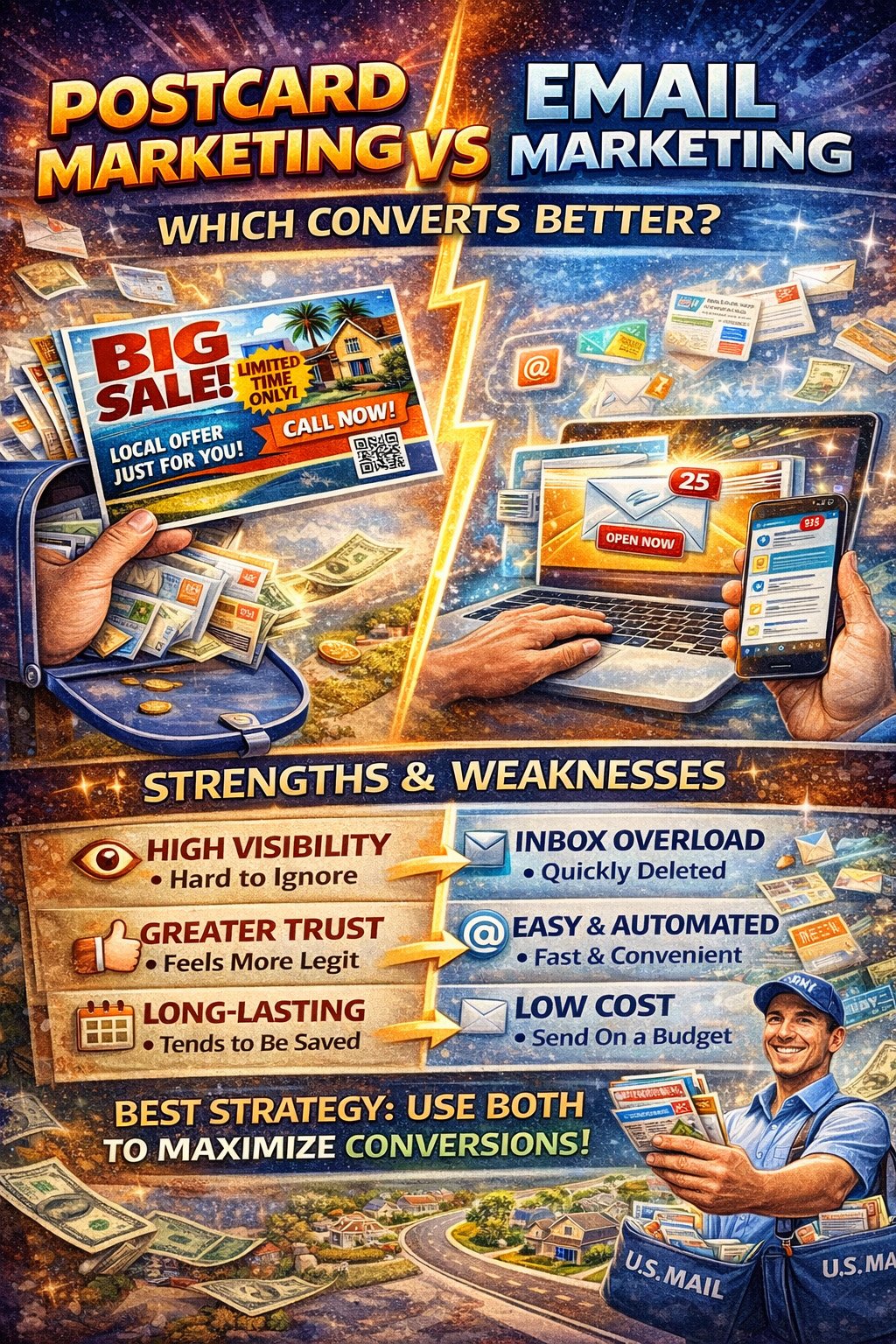
Businesses today have more ways than ever to reach potential customers, but more options do not always make marketing easier. In fact, many business owners face the same question when planning a campaign: should they invest in postcard marketing or email marketing? Both channels can be effective. Both can generate leads, drive sales, and increase customer awareness. But they work in different ways, and their results often depend on the audience, message, and goal behind the campaign.
Email marketing is fast, inexpensive, and easy to scale. Postcard marketing is physical, highly visible, and often more memorable. One lives in the inbox. The other shows up in the mailbox. One can be ignored with a swipe or deleted in seconds. The other can sit on a counter, table, or refrigerator for days. So which one converts better?
The answer depends on what you mean by conversion, who you are targeting, and what kind of relationship you already have with your audience. To make the right decision, it helps to compare both channels honestly.
What Makes Email Marketing Attractive
Email marketing remains popular because it is efficient. Businesses can send messages to hundreds or thousands of contacts quickly, often at a low cost. It is easy to automate, easy to personalize, and easy to track. Open rates, click-through rates, and conversion actions can all be measured in real time.
This makes email especially useful for:
- Nurturing existing leads
- Promoting flash sales
- Sending reminders and follow-ups
- Sharing content and updates
- Encouraging repeat purchases
Email works best when the recipient already knows the business or has willingly joined a list. In those cases, email can be a strong way to stay connected and move people toward a purchase over time.
What Makes Postcard Marketing Powerful
Direct mail postcards offer something email cannot: physical presence. A postcard arrives in the real world, where it can be seen immediately without needing to be opened. The message is visible at a glance. The branding, offer, and call to action are already there.
This gives postcard marketing several important advantages:
- It stands out from digital clutter
- It feels more tangible and trustworthy
- It can reach people who ignore most emails
- It works well for local geographic targeting
- It often stays visible longer in the home
For local businesses, postcards are especially effective because they can reach households in specific neighborhoods, service areas, or carrier routes. That makes them a practical tool for generating awareness and response in a defined market.
The Visibility Factor
One of the biggest differences between postcards and email is visibility. Emails must be opened before the full message is seen. That means they first have to survive crowded inboxes, spam filters, promotions tabs, and fast deletion. A recipient may never even see the message, no matter how good the offer is.
Postcards work differently. They do not need to be opened. The recipient sees the headline, image, and business name immediately. That instant visibility gives postcards a major advantage when the goal is to get noticed fast.
If your message depends on immediate awareness, postcards often win that first battle more easily than email.
The Trust Factor
Trust plays a major role in conversions. People are more likely to respond when a business feels real, established, and credible. Email can certainly build trust over time, especially with consistent branding and useful content, but it also faces a major challenge: inbox fatigue. Many recipients are used to ignoring promotional emails, especially from companies they do not know well.
A postcard often feels more intentional. Because it is printed and mailed physically, it can create a stronger impression of legitimacy. For first-time outreach, this can make a difference. A business that shows up in the mailbox may feel more trustworthy than one that appears as just another promotional email.
The Cost Factor
Email marketing is usually cheaper on a per-message basis. That is one of its biggest strengths. Once you have a list and an email platform, sending additional emails costs very little. This makes email attractive for frequent communication and ongoing customer nurturing.
Postcards cost more to print and mail, so on the surface they seem more expensive. But cost alone does not determine value. What matters is cost compared to results. A cheaper message that gets ignored is not actually cheaper if it produces no response. A more expensive postcard can be the better investment if it generates more calls, appointments, or sales.
This is why businesses should think in terms of marketing ROI, not just delivery cost.
Which One Converts Better for New Customers?
For reaching brand-new prospects, postcards often have the edge. Cold email marketing is difficult because recipients may not know the sender, may not trust the message, or may never even open it. In contrast, a postcard can create instant awareness without relying on an existing relationship.
This makes postcards especially strong for:
- Local service businesses
- Grand openings
- Neighborhood promotions
- Real estate marketing
- Restaurant offers
- Medical and dental office promotions
If your goal is to get in front of people who have never heard of your business, postcard marketing often converts better because it creates stronger first-contact visibility.
Which One Converts Better for Existing Customers?
For existing customers or subscribers, email often performs very well. If people already know your brand, have purchased before, or signed up to hear from you, email becomes a highly efficient way to stay connected. It can remind, educate, upsell, and re-engage.
In these situations, email may convert better because the trust barrier is lower and the response path is immediate. A person can click and buy within seconds. That convenience gives email an advantage when communicating with warm audiences.
This is why many businesses use email for:
- Loyalty offers
- Abandoned cart reminders
- Membership renewals
- Product launches to subscribers
- Repeat customer promotions
Postcards Tend to Win on Memorability
Another major difference is how long the message lasts. Emails are often opened and forgotten in minutes, if they are opened at all. A postcard can remain in view for days or weeks. It may sit on a kitchen counter, desk, or refrigerator until the recipient is ready to act.
That staying power matters because many customers do not respond immediately. They respond when the need becomes relevant. A postcard that remains visible has more chances to trigger action later. This makes postcard marketing particularly strong for services that are needed periodically rather than instantly.
Email Tends to Win on Speed and Automation
While postcards may win on visibility and memorability, email has a clear advantage in speed. A business can create a campaign, schedule it, test variations, and send it almost instantly. Automated workflows can follow customer behavior, segment audiences, and send timely messages without manual effort.
This makes email ideal for fast-moving campaigns, time-sensitive reminders, and long-term nurturing systems. If your business needs ongoing communication at scale, email is difficult to replace.
The Best Answer Is Often Both
For many businesses, the smartest strategy is not choosing one over the other. It is using both together. Postcards can create strong first impressions and local visibility, while email can follow up, nurture interest, and make repeat communication easier.
For example, a prospect may first notice your business through a postcard. Later, they visit your website, sign up for updates, and begin receiving emails. The postcard creates awareness. The email deepens the relationship. Together, they create multiple touchpoints that improve trust and response.
This kind of integrated marketing often converts better than relying on a single channel alone.
Final Thoughts
So which converts better: postcard marketing or email marketing? For cold prospects and local visibility, postcards often have the advantage. For warm audiences and ongoing communication, email often performs better. Each channel has strengths, and the best choice depends on your audience, your offer, and your business goals.
At BigPostcards.net, postcard marketing remains one of the most effective ways to get seen, build trust, and generate action in a crowded world. Email may be fast and affordable, but postcards bring something different to the table: real-world presence that people notice and remember. When conversions matter, that difference can be powerful.