
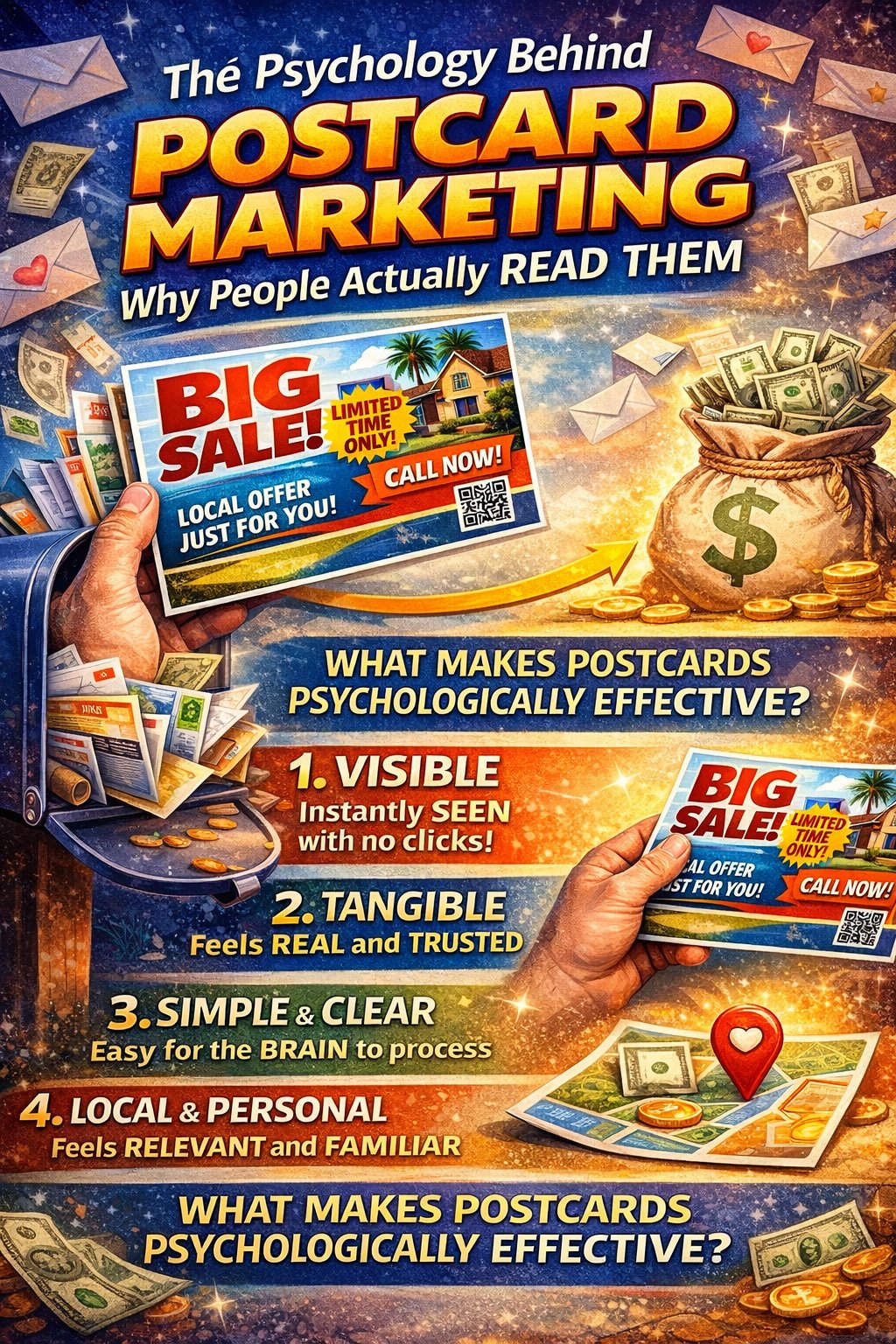
In a world full of pop-ups, paid ads, social media promotions, and inbox overload, getting people to stop and pay attention has become one of the biggest challenges in marketing. Businesses spend enormous amounts of time and money trying to win a few seconds of attention online. Yet one traditional format continues to hold surprising power in modern marketing: the postcard.
Postcard marketing works for a simple reason—it aligns with human behavior. People are more likely to notice, process, and remember messages that are visible, tangible, easy to understand, and emotionally relevant. That is exactly what postcards do. They reach people in a physical space, reduce friction, and create a more direct experience than many digital ads ever can.
To understand why postcards still perform so well, it helps to look at the psychology behind them. When you understand why people actually read postcards, you can design campaigns that feel more natural, more persuasive, and more effective.
Visibility Creates Instant Attention
One of the strongest psychological advantages of a postcard is that the message is already exposed. There is no envelope to open, no subject line to decide on, and no click required to reveal the offer. The recipient sees the image, headline, branding, and main message immediately.
This matters because human attention is selective and fast. People are constantly filtering information, deciding almost instantly what is worth noticing and what should be ignored. A postcard removes an extra step and makes the message effortless to access. That instant visibility gives it a better chance of entering awareness before the person decides to move on.
In psychology, reducing effort increases engagement. The easier something is to process, the more likely people are to give it a moment of attention. Postcards benefit from that principle naturally.
Tangible Objects Feel More Real
Digital content often feels temporary. A message appears, disappears, and is replaced by another within seconds. A postcard feels different because it is physical. It exists in the real world. It can be held, turned over, placed on a table, pinned to a board, or saved for later.
That physical presence affects perception. Tangible materials often feel more serious, more intentional, and more trustworthy than something that flashes by on a screen. People tend to place greater mental value on objects they can physically interact with. This is one reason direct mail often feels more credible than digital advertising.
For businesses, this means a postcard can create a stronger sense of legitimacy. Instead of seeming like just another online promotion, it feels like a direct communication from a real business trying to make a real connection.
Simplicity Helps the Brain Process the Message
Another reason people read postcards is that postcards are usually simple. They tend to focus on one message, one offer, and one action step. That simplicity makes them easier for the brain to process quickly.
People do not like cognitive overload. When a message is cluttered, confusing, or full of too many competing ideas, the brain often rejects it. A good postcard avoids that problem. It delivers a short, visually clear communication that answers the most important questions fast:
- Who is this from?
- What is being offered?
- Why should I care?
- What should I do next?
This clarity is powerful because it reduces mental resistance. The easier a message is to understand, the easier it is to act on.
Novelty Makes People Pause
People become blind to patterns they see too often. Online, most promotions look familiar: banner ads, sponsored posts, pre-roll videos, retargeting ads, and email offers all compete for attention in highly repetitive ways. Because of that repetition, many consumers automatically tune them out.
A postcard can interrupt that pattern. In a digital-heavy environment, physical mail feels different. That difference creates novelty, and novelty naturally attracts attention. The brain is wired to notice what stands out from the expected environment.
Even if someone receives mail regularly, a well-designed postcard can still create a small pattern break that makes the recipient stop, look, and read. That pause is valuable. In marketing, even a few extra seconds of focused attention can dramatically increase response.
Postcards Trigger Local and Personal Relevance
Relevance is one of the most important psychological drivers of response. People pay more attention when a message feels connected to their life, location, needs, or identity. Postcards are especially strong at creating that feeling because they often target specific neighborhoods, communities, or customer groups.
A postcard that promotes a nearby business, a local event, or a service available in the recipient’s area feels more relevant than a random online ad from a company they have never heard of. It creates the sense that the message was meant for them.
This local relevance is one reason postcards work so well for:
- Home services
- Restaurants and local offers
- Dental and medical offices
- Retail store promotions
- Real estate marketing
- Community announcements and events
When the offer feels close, useful, and timely, people are much more likely to read and respond.
Trust Grows Through Familiarity
One of the most studied ideas in psychology is the familiarity effect. The more often people see something, the more comfortable and believable it tends to feel. Postcards help build familiarity because they place the business name, logo, colors, and offer directly into the home.
A person may not respond the first time they receive a postcard, but that first exposure still matters. The next time they see the business name online, pass the storefront, or hear someone mention the company, it feels more familiar. That familiarity lowers resistance and increases the chance of future action.
This is why repeated postcard campaigns often outperform one-time mailings. Trust rarely appears instantly. It grows through repeated, consistent exposure.
Emotion Plays a Bigger Role Than Most Businesses Realize
People do not make decisions based on logic alone. Emotion influences attention, memory, and action. A postcard that uses strong imagery, appealing colors, a warm local tone, or an exciting offer can create a small emotional response that makes the message more memorable.
Depending on the industry, that emotional trigger might be:
- Relief from a household problem
- Excitement about a sale or promotion
- Curiosity about a new service
- Confidence in a trusted local provider
- Urgency tied to a limited-time offer
Emotion helps turn passive reading into active interest. When the postcard connects with a real need or desire, the recipient is far more likely to respond.
Clear Calls to Action Reduce Decision Friction
Another psychological strength of postcards is that they can guide action clearly. When a postcard says exactly what to do next—call, visit, book, scan, or redeem—it removes uncertainty. This matters because uncertainty often kills response.
People hesitate when they are not sure what step comes next. A strong postcard eliminates that hesitation with a direct and simple call to action. The easier the next step feels, the more likely the recipient is to take it.
Good postcards often use calls to action like:
- Call today for your free quote
- Bring this postcard in for 15% off
- Scan the QR code to book now
- Visit us this weekend for special savings
These instructions work because they reduce decision fatigue and turn intention into movement.
Why Businesses Should Pay Attention to This Psychology
Understanding why people read postcards is more than an academic exercise. It has direct business value. When you design postcards around real human behavior, your campaigns become stronger. You stop relying on guesswork and start using principles that naturally support attention, trust, and response.
Businesses that understand postcard psychology can create campaigns that are:
- More visible
- More memorable
- More relevant
- More persuasive
- More likely to generate action
In a marketing environment where so many messages are ignored, these advantages matter.
Final Thoughts
Postcards work because they match the way people actually think and behave. They are visible, physical, easy to process, emotionally engaging, and often highly relevant. They reduce friction, support trust, and create a more memorable experience than many digital messages.
At BigPostcards.net, effective postcard marketing starts with understanding people—not just printing materials. When businesses respect attention, clarity, trust, and emotion, postcards become far more than simple mail pieces. They become powerful tools for getting read, getting remembered, and getting results.