Big Postcards

Main Menu

  • Home
  • Big Postcards
  • Ravens Design Shop
  1. You are here:  
  2. Home
  3. Big Postcards

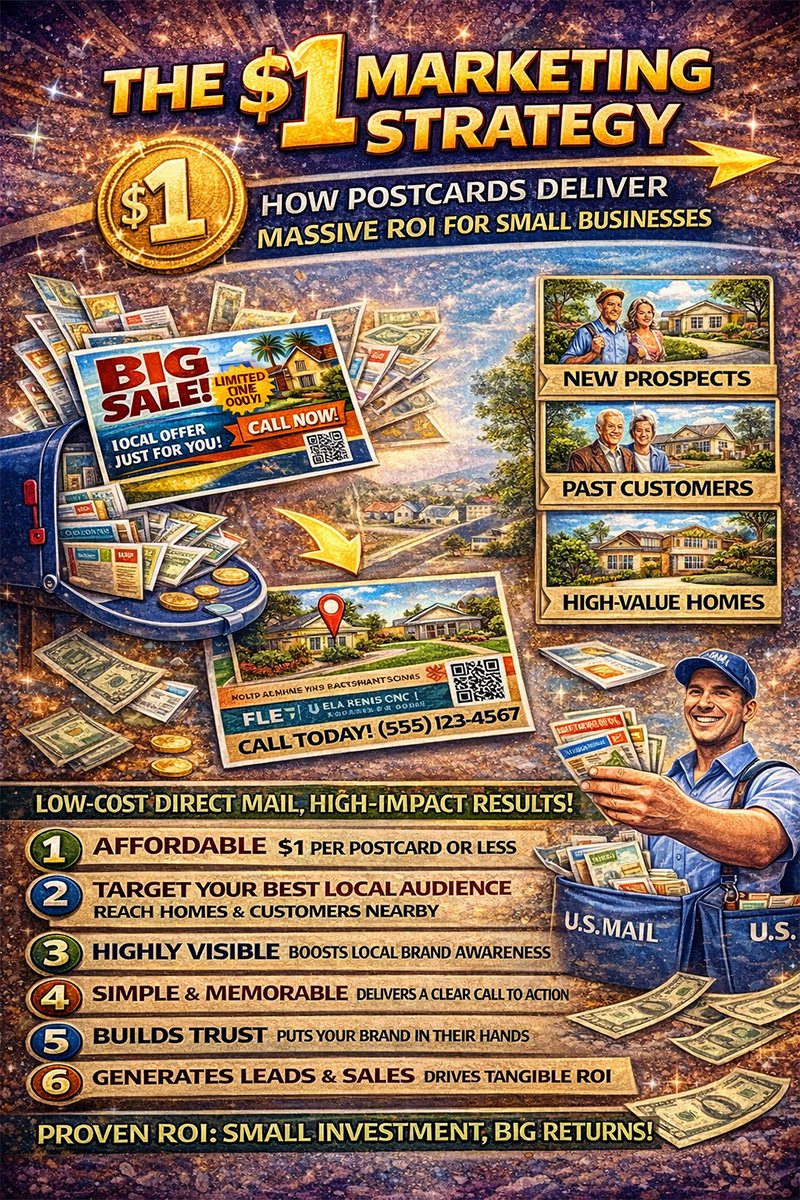
The $1 Marketing Strategy: How Postcards Deliver Massive ROI for Small Businesses

 article 10

Small businesses rarely have unlimited marketing budgets. Every dollar has to work. Every campaign has to justify itself. That is why the smartest business owners are always looking for practical ways to generate leads, attract customers, and build awareness without wasting money on channels that are overcrowded, overpriced, or easy to ignore. One of the most reliable options is postcard marketing.

Postcards offer something many other marketing channels struggle to deliver at the same time: visibility, affordability, simplicity, and strong local impact. They are easy to understand, easy to distribute, and effective at getting your business noticed in a real-world setting. For many local companies, a postcard can become the foundation of a highly profitable campaign.

When people talk about a “$1 marketing strategy,” they are talking about efficiency. They mean a marketing approach where a small investment can create a meaningful return. In that sense, postcards are one of the best examples. A modest spend on direct mail can create awareness, trust, and response in the exact neighborhoods where small businesses need it most.

Why Small Businesses Need Cost-Effective Marketing

Large brands can afford to spread their budgets across many channels at once. Small businesses usually do not have that luxury. They need marketing that reaches the right people, delivers a clear message, and creates measurable action without requiring a large team or complicated systems.

This is why marketing efficiency matters so much. A campaign should not only look good. It should bring back more than it costs. Whether the goal is more phone calls, more appointments, more foot traffic, or more online inquiries, the strategy should be built around real return.

Direct mail postcards fit this need well because they are practical, targeted, and often highly visible. Instead of trying to compete in a crowded digital environment alone, postcards give small businesses a way to put their message directly into the hands of nearby prospects.

Postcards Get Seen Faster Than Many Ads

One of the biggest challenges in marketing is simply getting noticed. Emails go unopened. Social media ads disappear in seconds. Search ads depend on timing and competition. Postcards work differently because they do not need a click or an open to reveal the message. The recipient sees the business name, offer, and design immediately.

That instant visibility matters. Small businesses do not always have the budget for endless retargeting or repeated digital impressions. A postcard can create a strong first impression the moment it reaches the mailbox. That makes it especially useful for local promotions, neighborhood offers, grand openings, and service-based businesses that depend on visibility in a defined area.

Affordable Does Not Mean Weak

Some business owners assume that lower-cost marketing channels must produce weaker results. That is not necessarily true. The real value of a campaign depends on performance, not just price. A postcard may cost less than many large-scale advertising options, yet still produce excellent returns when it is sent to the right audience with the right message.

This is what makes postcard marketing such a strong fit for small businesses. It can be affordable enough to test, repeat, and refine, while still powerful enough to generate measurable response. A campaign does not need a massive budget to work well. It needs relevance, clarity, and consistency.

Local Targeting Makes Every Dollar Work Harder

One reason postcards deliver strong ROI is that they can be highly targeted by geography. Small businesses often do not need broad exposure. They need local exposure. They need homeowners, families, and customers in nearby neighborhoods to know who they are.

Postcards make this possible by allowing businesses to focus on the areas most likely to produce results. A restaurant can target nearby households. A roofer can mail specific neighborhoods. A dental office can promote a new patient offer in surrounding zip codes. A retail store can announce a seasonal sale to homes within driving distance.

This geographic focus reduces waste. Instead of spending money trying to reach people outside the service area, the business invests where response is more likely. That is one of the biggest secrets behind strong postcard marketing ROI.

Simple Messages Often Convert Best

Postcards work especially well for small businesses because they force clarity. There is limited space, which encourages a focused message. A good postcard usually centers on one clear offer, one strong benefit, and one direct call to action.

This simplicity helps the campaign perform better. Recipients do not need to decode a complicated message. They can quickly understand:

  • Who the business is
  • What is being offered
  • Why it matters
  • What to do next

In marketing, clarity drives action. Small businesses often benefit from postcards because they remove unnecessary complexity and make the path to response much shorter.

Postcards Build Trust in a Tangible Way

Trust matters for every business, but it matters even more for small and local companies trying to win new customers. People are more likely to respond when a business feels real, established, and relevant to their community.

A postcard can help create that feeling because it is physical. It shows that the business made the effort to reach out directly. It does not feel as temporary as many digital messages. It can also include trust-building details such as:

  • Customer testimonials
  • Locally owned messaging
  • Years in business
  • Guarantees or warranties
  • Professional certifications
  • Clear contact information

These elements increase credibility and make it easier for prospects to take the next step.

Postcards Work Across Many Small Business Types

Another reason postcards can deliver massive return is their flexibility. They work across a wide range of industries, especially those that rely on local visibility and direct response.

Small businesses that often benefit from postcards include:

  • Plumbers, HVAC companies, roofers, and electricians
  • Restaurants, cafes, and takeout businesses
  • Dental, medical, and wellness offices
  • Retail stores and boutiques
  • Real estate professionals
  • Gyms, salons, and service providers

In these industries, one new customer can easily cover the cost of many postcards. That is why the return potential can be so strong.

Repeat Mailings Can Multiply Results

Small business owners sometimes judge postcard marketing too quickly after one campaign. But like most good marketing, direct mail often performs best with repetition. The first postcard creates awareness. The second builds familiarity. The third may arrive just when the customer is ready to act.

This repeated exposure is valuable because people often need multiple touchpoints before they respond. A postcard that seems unnoticed today may still plant the seed for a call later. When businesses stay consistent in the same neighborhoods, their brand begins to feel established and recognizable.

That kind of familiarity can dramatically improve long-term return.

How to Improve ROI With Better Postcard Strategy

A postcard campaign becomes more profitable when a few key elements are handled well:

  1. Target the right audience so the message reaches people likely to care.
  2. Use a compelling offer that creates a clear reason to respond.
  3. Make the design bold and readable so the message is understood quickly.
  4. Include a strong call to action that tells the reader what to do next.
  5. Track results with phone numbers, QR codes, promo codes, or landing pages.
  6. Repeat strategically to build awareness and response over time.

The stronger these elements are, the more likely the postcard is to produce real business growth.

Why Postcards Still Make Sense in a Digital World

Some businesses assume that direct mail must be outdated because digital marketing is everywhere. In reality, that is one reason postcards stand out so well. Digital channels are crowded. People are flooded with emails, ads, and notifications every day. A postcard feels different because it enters the home in a physical form and competes in a less crowded space.

That difference gives small businesses an advantage. Instead of trying to outbid larger competitors everywhere online, they can use postcards to show up in local mailboxes with a direct, clear, and memorable message.

Final Thoughts

The $1 marketing strategy is not about finding a magic shortcut. It is about using affordable marketing wisely. Postcards deliver massive ROI for small businesses because they combine visibility, targeting, trust, and simplicity in a way that often leads to real action. When done well, even a modest postcard campaign can generate leads, new customers, and long-term brand growth.

At BigPostcards.net, postcard marketing is more than printed mail. It is one of the smartest ways for small businesses to stretch their marketing budget and create results that matter. When every dollar counts, postcards can make that dollar work harder.
Big Postcards Related Articles

  • 5 High-Converting Postcard Designs That Drive Real Business Results
  • Big Postcards, Bigger Results: How Size Impacts Direct Mail ROI
  • Every Door Direct Mail (EDDM): The Ultimate Local Marketing Hack
  • From Mailbox to Money: How Postcards Turn Prospects Into Customers
  • How to Create a Postcard Campaign That Gets a 4–9% Response Rate
  • Postcard Marketing vs Email Marketing: Which Converts Better?
  • Targeted Direct Mail Secrets: Reaching the Right Audience Every Time
  • The $1 Marketing Strategy: How Postcards Deliver Massive ROI for Small Businesses
  • The Psychology Behind Postcard Marketing: Why People Actually Read Them
  • Why Postcard Marketing Still Works in 2026

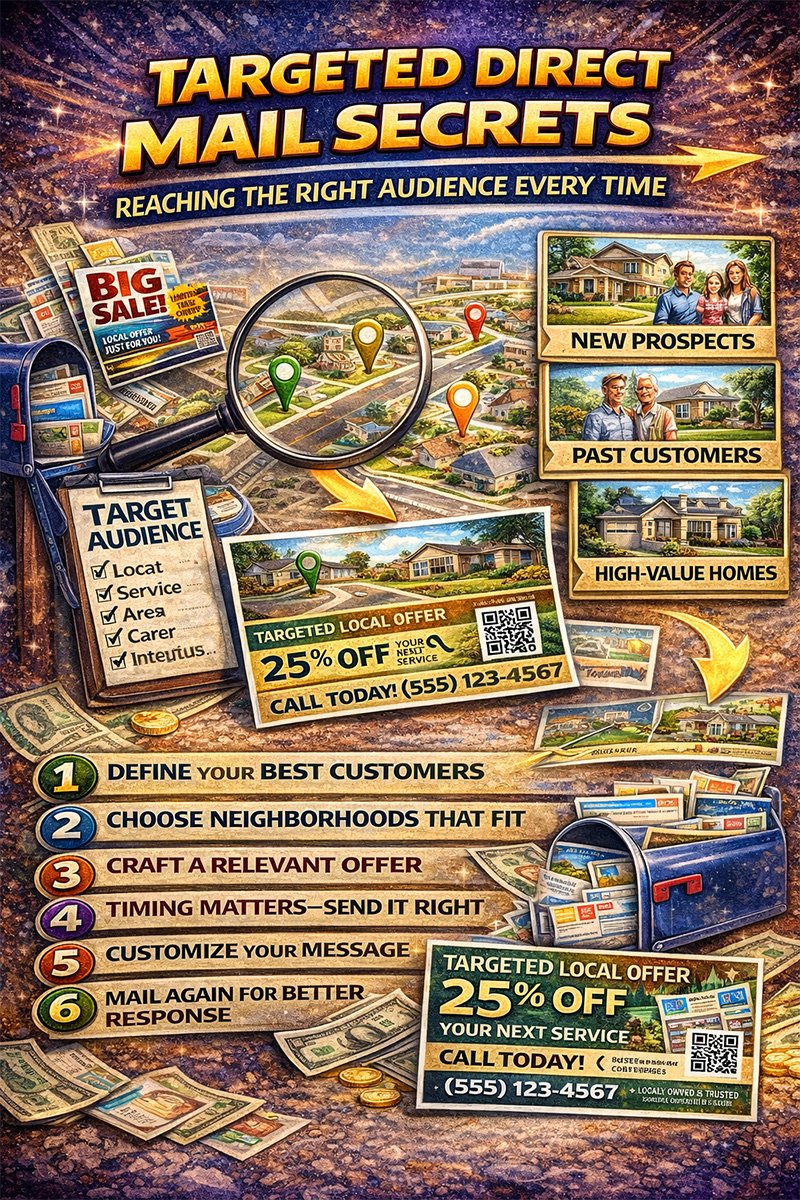
Targeted Direct Mail Secrets: Reaching the Right Audience Every Time

 article 9

Direct mail is one of the most practical ways to get your message in front of real people, but not every campaign performs the same. Some postcards generate calls, appointments, and steady sales. Others disappear into the mailbox with very little response. The difference usually comes down to one thing: targeting.

A postcard can have strong design, high-quality printing, and a generous offer, but if it reaches the wrong audience, it will struggle to perform. On the other hand, even a simple mail piece can produce excellent results when it reaches the people most likely to care. That is why targeted direct mail remains one of the smartest marketing strategies for businesses that want better response and better return on investment.

The secret is not sending more mail. The secret is sending smarter mail. When you understand how to match your message to the right people, your campaigns become more relevant, more persuasive, and more profitable.

Why Targeting Matters So Much in Direct Mail

People respond when a message feels relevant. If a postcard arrives that matches a current need, solves a problem, or offers something useful in the recipient’s area, it has a real chance of getting attention. If it feels random, generic, or unrelated, it is far easier to ignore.

This is why audience selection is one of the biggest drivers of direct mail ROI. The closer your message matches the needs of the recipient, the more likely they are to read, remember, and respond. Relevance creates interest, and interest is what leads to action.

Smart targeting helps businesses stop wasting money on broad mailings that reach people outside the ideal market. Instead of hoping someone might be interested, targeted direct mail increases the odds that the right households or customers receive the right offer at the right time.

Start With a Clear Customer Profile

One of the best direct mail secrets is also one of the simplest: know exactly who you want to reach before you create the postcard. Many campaigns underperform because the business starts with design before it defines the audience.

A strong customer profile may include details such as:

  • Location or service area
  • Homeowner or renter status
  • Family size or household type
  • Age range
  • Income level
  • Past customer behavior
  • Likely interest in specific services or offers

The better you understand your ideal customer, the easier it becomes to write a message that feels relevant and useful. A postcard should never feel like it was sent to “everyone.” It should feel like it was meant for someone specific.

Geographic Targeting Is a Powerful Advantage

One of the biggest strengths of postcard marketing is geographic precision. Businesses can target neighborhoods, zip codes, routes, or service areas that matter most to them. This makes direct mail especially effective for companies that depend on local customers.

Geographic targeting works well because it keeps the message close to the recipient’s world. A nearby business, a neighborhood offer, or a local service feels more relevant than a broad message coming from far away.

This is especially useful for:

  • Home service providers
  • Restaurants and local food businesses
  • Dental and medical offices
  • Retail stores and boutiques
  • Real estate professionals
  • Fitness and wellness businesses

When your business serves a specific area, targeted direct mail helps you put your brand exactly where it needs to be.

Use Different Offers for Different Audiences

A common mistake in direct mail is using one offer for every audience. Not all prospects respond to the same message. New customers may need an introductory incentive. Existing customers may respond better to loyalty rewards. Past customers may need a reactivation offer. High-value neighborhoods may respond better to premium positioning than heavy discounts.

This is where targeting becomes strategic. The more carefully you match the offer to the audience, the more likely the postcard is to convert.

For example:

  • New prospects may respond to a first-time discount
  • Past customers may respond to a welcome-back special
  • Luxury homeowners may respond to quality and trust messaging
  • Budget-conscious households may respond to savings-focused language

Good targeting is not just about where the postcard goes. It is also about what the postcard says once it gets there.

Timing Makes Targeting Even Stronger

The best direct mail campaigns do not just reach the right people. They reach them at the right moment. Timing can make a strong audience strategy even more effective because relevance increases when an offer matches what people need right now.

Seasonal timing is a great example. A landscaping postcard will often perform better in spring than in winter. A heating service offer may get better results in fall. A back-to-school promotion works best before the school season starts.

Timing also matters for life stages, events, and local patterns. A restaurant may mail a neighborhood coupon before a holiday weekend. A real estate agent may target homeowners when the local market is especially active. A home service provider may focus on neighborhoods after storms or during peak maintenance months.

Targeting becomes much more powerful when the message feels timely as well as relevant.

Past Customer Data Can Improve Results

One of the most valuable sources of targeting insight is your own customer base. Businesses often overlook the information they already have. Past customer data can reveal patterns that help improve future campaigns.

Useful patterns may include:

  • Which neighborhoods produced the most customers
  • Which offers performed best
  • Which services are purchased most often
  • How frequently customers return
  • What times of year generate the most demand

By studying what has worked before, businesses can target more confidently and reduce guesswork. This helps direct mail become more strategic with every campaign.

Design Should Support the Targeting Strategy

Once you know who the postcard is for, the design should reflect that audience. A postcard meant for luxury homeowners should not feel cheap or cluttered. A postcard aimed at busy families should be quick and easy to scan. A mail piece for older homeowners may need larger text and a straightforward layout.

The design, tone, and imagery should all match the people receiving the card. This creates a stronger sense of fit. When the audience feels understood, trust rises. When trust rises, response usually follows.

Good targeting and good design work together. One helps the postcard reach the right people. The other helps it connect once it arrives.

Repetition Helps Build Familiarity

Another important secret of targeted direct mail is consistency. Many people do not respond the first time they see a business name. That does not mean the postcard failed. It may have created awareness that pays off later.

Repeated mailings to the same targeted audience help build familiarity. When recipients see your brand again and again in their mailbox, your business begins to feel established and recognizable. This is especially useful in competitive local markets.

The goal is not to overwhelm the audience. The goal is to stay visible enough that when the need appears, your business is already top of mind.

Track Results by Audience Segment

Businesses that want better results from direct mail marketing should track response by audience group whenever possible. This helps identify which neighborhoods, offers, and customer types perform best.

Tracking methods may include:

  • Promo codes by area
  • Unique phone numbers
  • Segment-specific landing pages
  • QR codes tied to specific mail drops
  • Offer-specific coupons

Once you know which audiences respond best, you can focus more of your budget there and improve results over time. This is where targeted direct mail becomes a true system instead of a one-time campaign.

What Reaching the Right Audience Really Means

Reaching the right audience is not only about demographics or geography. It is about alignment. The right audience is the group most likely to care about your message, trust your business, and act on your offer. That alignment happens when several things work together:

  1. The audience fits the service or product
  2. The offer fits the audience’s needs
  3. The timing fits the moment
  4. The design fits the audience’s expectations
  5. The message feels relevant and easy to act on

When those pieces come together, direct mail stops feeling random and starts feeling precise.

Final Thoughts

Targeted direct mail works because relevance works. Businesses do not need to reach everyone to succeed. They need to reach the right people with the right message. When a postcard feels local, timely, useful, and clearly designed for the recipient, response becomes much more likely.

At BigPostcards.net, the real secret behind successful direct mail is not sending more pieces. It is sending smarter ones. When you target carefully, speak clearly, and track what works, direct mail becomes one of the most effective ways to connect with the right audience every time.

Big Postcards Related Articles

  • 5 High-Converting Postcard Designs That Drive Real Business Results
  • Big Postcards, Bigger Results: How Size Impacts Direct Mail ROI
  • Every Door Direct Mail (EDDM): The Ultimate Local Marketing Hack
  • From Mailbox to Money: How Postcards Turn Prospects Into Customers
  • How to Create a Postcard Campaign That Gets a 4–9% Response Rate
  • Postcard Marketing vs Email Marketing: Which Converts Better?
  • Targeted Direct Mail Secrets: Reaching the Right Audience Every Time
  • The $1 Marketing Strategy: How Postcards Deliver Massive ROI for Small Businesses
  • The Psychology Behind Postcard Marketing: Why People Actually Read Them
  • Why Postcard Marketing Still Works in 2026

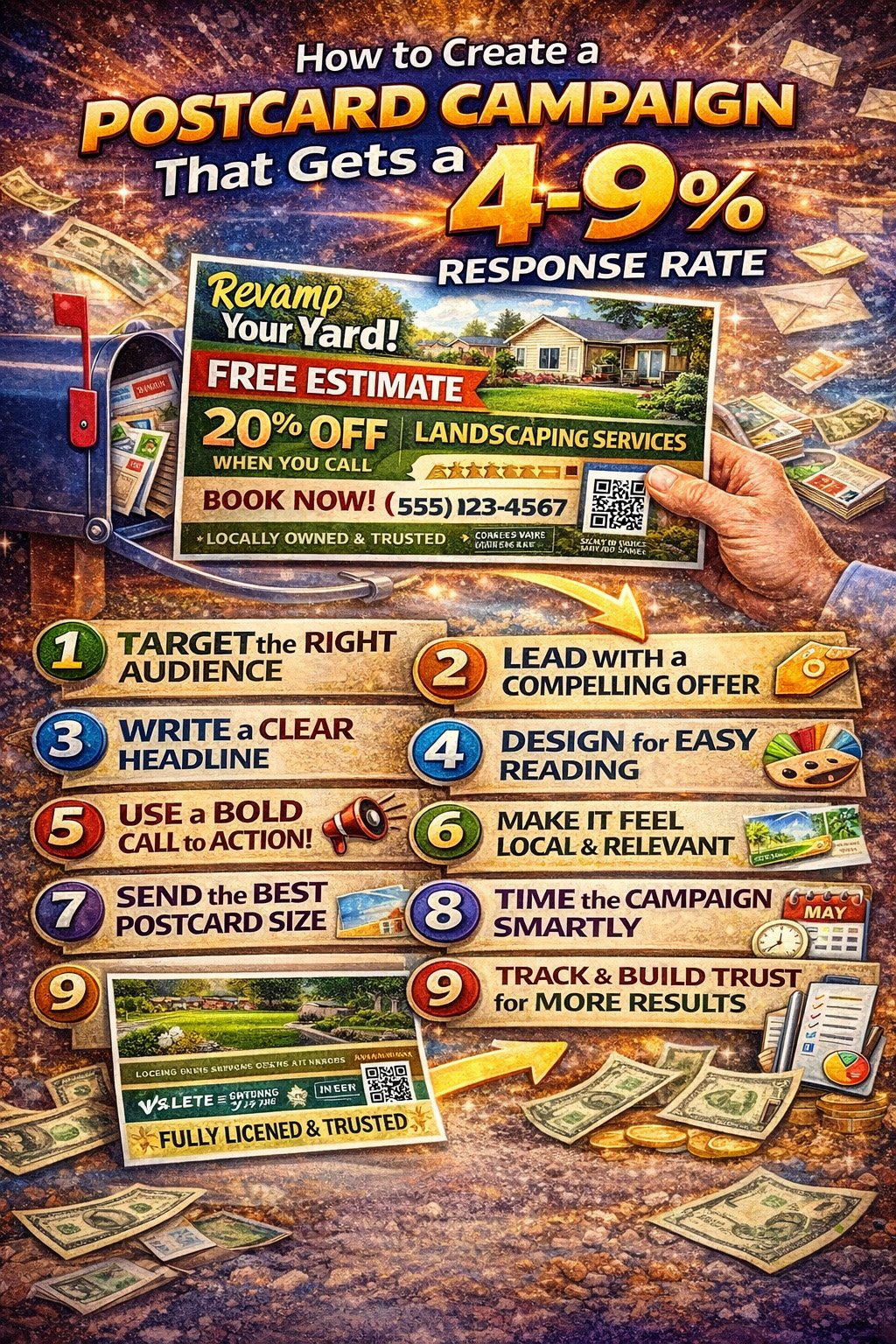
How to Create a Postcard Campaign That Gets a 4–9% Response Rate

article 8

Businesses do not send postcards just to fill mailboxes. They send them to generate attention, leads, sales, appointments, and long-term customer growth. The real question is not whether postcard marketing works. The real question is how to create a postcard campaign that performs well enough to make a measurable difference.

A strong campaign is never just about printing something attractive and mailing it out. High-performing direct mail campaigns are built on strategy. They combine the right audience, the right offer, the right design, and the right timing. When those elements work together, postcard marketing can produce impressive results and generate response rates that many digital channels struggle to match.

If your goal is to build a postcard campaign that gets a 4–9% response rate, the key is to focus on what makes recipients notice, trust, and act. Here is how to do it.

Start With the Right Audience

No postcard will perform well if it reaches the wrong people. Audience targeting is one of the most important factors in any successful campaign. Before you think about colors, headlines, or printing sizes, you need to know exactly who should receive your postcard.

Ask yourself:

  • Who is most likely to need this offer right now?
  • Which neighborhoods or zip codes make the most sense?
  • Am I targeting current customers, past customers, or brand-new prospects?
  • Does this message fit homeowners, renters, families, businesses, or another group?

The more relevant your audience, the stronger your response rate will be. A postcard sent to a carefully selected local market will usually outperform one sent too broadly. Relevance is what turns a generic mail piece into a meaningful opportunity.

Lead With a Clear and Compelling Offer

One of the biggest reasons postcard campaigns fail is weak offers. If the recipient does not immediately see a good reason to respond, the postcard becomes easy to ignore. A strong offer creates urgency, relevance, and motivation.

Good postcard offers often include:

  • Discounts for first-time customers
  • Free estimates or consultations
  • Limited-time seasonal specials
  • Exclusive neighborhood promotions
  • Buy one, get one deals
  • Bonus gifts or add-on services

The best offers are specific and easy to understand. Instead of vague language, make the value obvious. Recipients should instantly know what they get and why it is worth acting now.

Use a Headline That Gets Immediate Attention

In direct mail, attention happens fast. Most recipients glance at a postcard for only a few moments before deciding whether to keep reading or move on. Your headline has to do a lot of work in very little time.

A strong headline should communicate one main benefit clearly. It should not be clever at the expense of clarity. It should tell the reader why this postcard matters to them.

Effective headline styles include:

  • Save 20% on Your First Service
  • Local Homeowners: Get a Free Roof Inspection
  • Grand Opening Specials This Weekend Only
  • Claim Your Neighborhood Discount Today

The goal is simple: make the recipient stop long enough to want more information.

Keep the Design Clean and Easy to Scan

High-response postcard design is not about cramming in every detail. It is about creating a layout that feels clear, bold, and easy to process. People should be able to understand the postcard quickly without effort.

A clean postcard design usually includes:

  • One strong headline
  • One main offer
  • One or two supporting visuals
  • Simple body copy
  • A clear call to action
  • Readable contact information

Too much text, too many images, or too many competing messages can reduce response. The best postcards feel organized and intentional. They guide the eye naturally from headline to offer to action step.

Make the Call to Action Impossible to Miss

A postcard may get attention and create interest, but it will still underperform if the next step is unclear. Recipients need to know exactly what to do after reading your message.

Strong calls to action often use direct language such as:

  • Call today for your free estimate
  • Scan the QR code to book now
  • Bring this card in for 15% off
  • Visit our website to claim your offer
  • Book before Friday to save

Your call to action should be easy to find, easy to understand, and easy to complete. The more friction you remove, the more likely people are to respond.

Use Local Relevance to Increase Response

Postcards perform especially well when they feel local and personal. People respond more often when they believe a message is relevant to their area, their needs, and their daily life. This is why localized marketing often outperforms generic promotions.

You can make postcards feel more relevant by including:

  • Neighborhood-specific language
  • City or community names
  • Offers tailored to local weather or seasonal needs
  • Photos or references that feel familiar to the area
  • Local trust signals such as reviews, awards, or years serving the community

When people feel the message was made for them, response becomes much more likely.

Choose the Right Postcard Size

Size can make a difference in response because larger postcards stand out more in the mailbox. A bigger format often gives you more room for strong visuals, better readability, and a more professional appearance.

While smaller postcards can still work, larger cards often perform better because they are harder to ignore. If your goal is maximum visibility, a bigger postcard can help you make a stronger first impression.

The key is not just size for the sake of size. It is using that extra space wisely so the design feels bold rather than cluttered.

Time the Campaign Carefully

Timing can significantly affect postcard performance. A strong campaign should arrive when the offer is most relevant. For example, a landscaping postcard may work best in spring, a furnace checkup offer may perform best in fall, and a holiday promotion may perform best just before the shopping season begins.

Timing also matters for urgency. Limited-time promotions tend to perform better when the deadline is realistic but not too far away. A postcard that feels timely encourages faster decisions.

In many cases, repeated mailings work better than a single drop. The first postcard builds awareness. The second reinforces it. The third often catches people when the need becomes immediate.

Track Responses So You Know What Works

Businesses that get strong results from postcard marketing usually track their campaigns carefully. If you do not measure response, it becomes much harder to improve future mailings.

Common tracking methods include:

  • Unique phone numbers
  • Promo codes
  • QR codes
  • Dedicated landing pages
  • Offer-specific URLs
  • In-store coupon redemption

Tracking shows you which offers, designs, audiences, and neighborhoods perform best. That information can help you raise response rates over time and improve overall direct mail ROI.

Build Trust Into the Postcard

Trust influences action more than many businesses realize. A postcard that looks credible and professional is more likely to convert than one that feels generic or uncertain. Recipients want to feel confident that the business is legitimate and worth contacting.

Trust-building elements may include:

  • Customer testimonials
  • Years in business
  • Guarantees or warranties
  • Professional certifications
  • Locally owned messaging
  • Clear branding and polished design

These details make the postcard feel more believable, and that can be the difference between interest and action.

What High-Response Campaigns Have in Common

Postcard campaigns that perform in the 4–9% range often share the same strengths:

  1. A sharply targeted audience
  2. A valuable and relevant offer
  3. A bold, clear headline
  4. A clean, readable layout
  5. A strong call to action
  6. Good timing and repeated exposure
  7. Easy response tracking

None of these factors work as well alone as they do together. High response is usually the result of strategic alignment, not luck.

Final Thoughts

A postcard campaign that gets a strong response rate is built intentionally. It reaches the right people with the right message at the right time and makes action feel easy. That is what separates postcards that get tossed aside from postcards that generate real business results.

At BigPostcards.net, successful postcard marketing is about more than print. It is about creating campaigns that get noticed, get remembered, and get results. When the offer is strong, the targeting is smart, and the design is built to convert, postcards can become one of the most effective tools in your marketing system.

Big Postcards Related Articles

  • 5 High-Converting Postcard Designs That Drive Real Business Results
  • Big Postcards, Bigger Results: How Size Impacts Direct Mail ROI
  • Every Door Direct Mail (EDDM): The Ultimate Local Marketing Hack
  • From Mailbox to Money: How Postcards Turn Prospects Into Customers
  • How to Create a Postcard Campaign That Gets a 4–9% Response Rate
  • Postcard Marketing vs Email Marketing: Which Converts Better?
  • Targeted Direct Mail Secrets: Reaching the Right Audience Every Time
  • The $1 Marketing Strategy: How Postcards Deliver Massive ROI for Small Businesses
  • The Psychology Behind Postcard Marketing: Why People Actually Read Them
  • Why Postcard Marketing Still Works in 2026

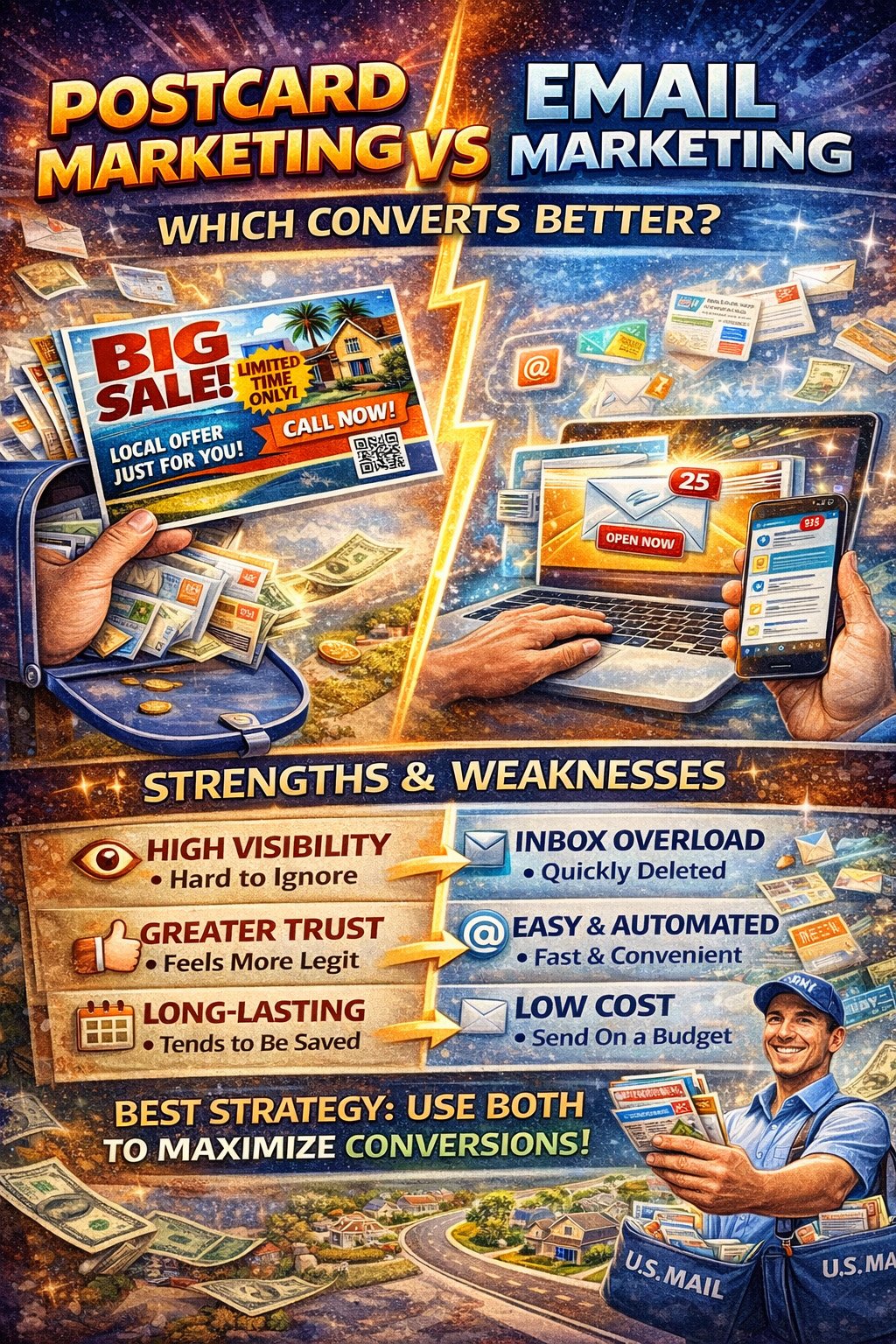
Postcard Marketing vs Email Marketing: Which Converts Better?

 article 7

Businesses today have more ways than ever to reach potential customers, but more options do not always make marketing easier. In fact, many business owners face the same question when planning a campaign: should they invest in postcard marketing or email marketing? Both channels can be effective. Both can generate leads, drive sales, and increase customer awareness. But they work in different ways, and their results often depend on the audience, message, and goal behind the campaign.

Email marketing is fast, inexpensive, and easy to scale. Postcard marketing is physical, highly visible, and often more memorable. One lives in the inbox. The other shows up in the mailbox. One can be ignored with a swipe or deleted in seconds. The other can sit on a counter, table, or refrigerator for days. So which one converts better?

The answer depends on what you mean by conversion, who you are targeting, and what kind of relationship you already have with your audience. To make the right decision, it helps to compare both channels honestly.

What Makes Email Marketing Attractive

Email marketing remains popular because it is efficient. Businesses can send messages to hundreds or thousands of contacts quickly, often at a low cost. It is easy to automate, easy to personalize, and easy to track. Open rates, click-through rates, and conversion actions can all be measured in real time.

This makes email especially useful for:

  • Nurturing existing leads
  • Promoting flash sales
  • Sending reminders and follow-ups
  • Sharing content and updates
  • Encouraging repeat purchases

Email works best when the recipient already knows the business or has willingly joined a list. In those cases, email can be a strong way to stay connected and move people toward a purchase over time.

What Makes Postcard Marketing Powerful

Direct mail postcards offer something email cannot: physical presence. A postcard arrives in the real world, where it can be seen immediately without needing to be opened. The message is visible at a glance. The branding, offer, and call to action are already there.

This gives postcard marketing several important advantages:

  • It stands out from digital clutter
  • It feels more tangible and trustworthy
  • It can reach people who ignore most emails
  • It works well for local geographic targeting
  • It often stays visible longer in the home

For local businesses, postcards are especially effective because they can reach households in specific neighborhoods, service areas, or carrier routes. That makes them a practical tool for generating awareness and response in a defined market.

The Visibility Factor

One of the biggest differences between postcards and email is visibility. Emails must be opened before the full message is seen. That means they first have to survive crowded inboxes, spam filters, promotions tabs, and fast deletion. A recipient may never even see the message, no matter how good the offer is.

Postcards work differently. They do not need to be opened. The recipient sees the headline, image, and business name immediately. That instant visibility gives postcards a major advantage when the goal is to get noticed fast.

If your message depends on immediate awareness, postcards often win that first battle more easily than email.

The Trust Factor

Trust plays a major role in conversions. People are more likely to respond when a business feels real, established, and credible. Email can certainly build trust over time, especially with consistent branding and useful content, but it also faces a major challenge: inbox fatigue. Many recipients are used to ignoring promotional emails, especially from companies they do not know well.

A postcard often feels more intentional. Because it is printed and mailed physically, it can create a stronger impression of legitimacy. For first-time outreach, this can make a difference. A business that shows up in the mailbox may feel more trustworthy than one that appears as just another promotional email.

The Cost Factor

Email marketing is usually cheaper on a per-message basis. That is one of its biggest strengths. Once you have a list and an email platform, sending additional emails costs very little. This makes email attractive for frequent communication and ongoing customer nurturing.

Postcards cost more to print and mail, so on the surface they seem more expensive. But cost alone does not determine value. What matters is cost compared to results. A cheaper message that gets ignored is not actually cheaper if it produces no response. A more expensive postcard can be the better investment if it generates more calls, appointments, or sales.

This is why businesses should think in terms of marketing ROI, not just delivery cost.

Which One Converts Better for New Customers?

For reaching brand-new prospects, postcards often have the edge. Cold email marketing is difficult because recipients may not know the sender, may not trust the message, or may never even open it. In contrast, a postcard can create instant awareness without relying on an existing relationship.

This makes postcards especially strong for:

  • Local service businesses
  • Grand openings
  • Neighborhood promotions
  • Real estate marketing
  • Restaurant offers
  • Medical and dental office promotions

If your goal is to get in front of people who have never heard of your business, postcard marketing often converts better because it creates stronger first-contact visibility.

Which One Converts Better for Existing Customers?

For existing customers or subscribers, email often performs very well. If people already know your brand, have purchased before, or signed up to hear from you, email becomes a highly efficient way to stay connected. It can remind, educate, upsell, and re-engage.

In these situations, email may convert better because the trust barrier is lower and the response path is immediate. A person can click and buy within seconds. That convenience gives email an advantage when communicating with warm audiences.

This is why many businesses use email for:

  • Loyalty offers
  • Abandoned cart reminders
  • Membership renewals
  • Product launches to subscribers
  • Repeat customer promotions

Postcards Tend to Win on Memorability

Another major difference is how long the message lasts. Emails are often opened and forgotten in minutes, if they are opened at all. A postcard can remain in view for days or weeks. It may sit on a kitchen counter, desk, or refrigerator until the recipient is ready to act.

That staying power matters because many customers do not respond immediately. They respond when the need becomes relevant. A postcard that remains visible has more chances to trigger action later. This makes postcard marketing particularly strong for services that are needed periodically rather than instantly.

Email Tends to Win on Speed and Automation

While postcards may win on visibility and memorability, email has a clear advantage in speed. A business can create a campaign, schedule it, test variations, and send it almost instantly. Automated workflows can follow customer behavior, segment audiences, and send timely messages without manual effort.

This makes email ideal for fast-moving campaigns, time-sensitive reminders, and long-term nurturing systems. If your business needs ongoing communication at scale, email is difficult to replace.

The Best Answer Is Often Both

For many businesses, the smartest strategy is not choosing one over the other. It is using both together. Postcards can create strong first impressions and local visibility, while email can follow up, nurture interest, and make repeat communication easier.

For example, a prospect may first notice your business through a postcard. Later, they visit your website, sign up for updates, and begin receiving emails. The postcard creates awareness. The email deepens the relationship. Together, they create multiple touchpoints that improve trust and response.

This kind of integrated marketing often converts better than relying on a single channel alone.

Final Thoughts

So which converts better: postcard marketing or email marketing? For cold prospects and local visibility, postcards often have the advantage. For warm audiences and ongoing communication, email often performs better. Each channel has strengths, and the best choice depends on your audience, your offer, and your business goals.

At BigPostcards.net, postcard marketing remains one of the most effective ways to get seen, build trust, and generate action in a crowded world. Email may be fast and affordable, but postcards bring something different to the table: real-world presence that people notice and remember. When conversions matter, that difference can be powerful.

Big Postcards Related Articles

  • 5 High-Converting Postcard Designs That Drive Real Business Results
  • Big Postcards, Bigger Results: How Size Impacts Direct Mail ROI
  • Every Door Direct Mail (EDDM): The Ultimate Local Marketing Hack
  • From Mailbox to Money: How Postcards Turn Prospects Into Customers
  • How to Create a Postcard Campaign That Gets a 4–9% Response Rate
  • Postcard Marketing vs Email Marketing: Which Converts Better?
  • Targeted Direct Mail Secrets: Reaching the Right Audience Every Time
  • The $1 Marketing Strategy: How Postcards Deliver Massive ROI for Small Businesses
  • The Psychology Behind Postcard Marketing: Why People Actually Read Them
  • Why Postcard Marketing Still Works in 2026

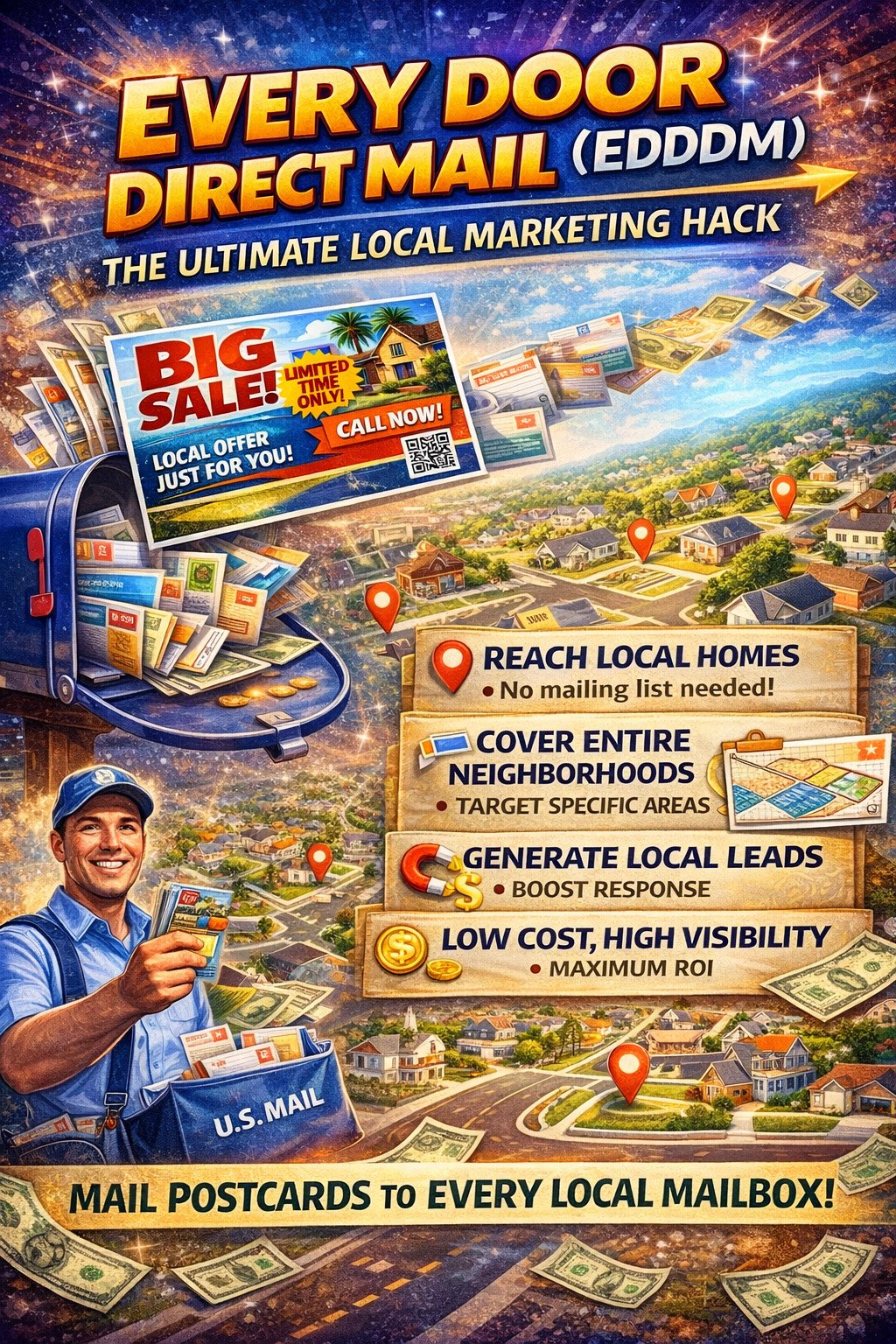
Every Door Direct Mail (EDDM): The Ultimate Local Marketing Hack

 article 6

For local businesses, visibility is everything. If people in your service area do not know your business exists, they cannot call, visit, book, or buy. That is why local marketing strategies matter so much. Businesses need practical ways to get their message in front of nearby households without wasting money on people outside their market. One of the most effective ways to do that is through Every Door Direct Mail (EDDM).

EDDM is a direct mail program that allows businesses to send marketing pieces to homes and businesses in specific carrier routes without needing a traditional mailing list. In simple terms, it lets you blanket selected local areas with your message. For many companies, that makes EDDM one of the smartest and most affordable tools for local growth.

Whether you are promoting a grand opening, introducing a service, announcing a seasonal offer, or simply trying to build neighborhood awareness, EDDM can help you reach the right audience where they live. That is why many marketers think of it as the ultimate local marketing hack.

What Is Every Door Direct Mail?

Every Door Direct Mail is a USPS-based marketing option that allows businesses to mail postcards, flyers, menus, or other approved formats directly to every address on selected delivery routes. Instead of buying, renting, or building a mailing list, you choose the neighborhoods you want to target and send your message to all the addresses in that area.

This makes EDDM especially useful for local businesses whose customers typically live or work nearby. Rather than paying to reach a broad audience, you can focus your message on the exact geographic areas most likely to respond.

EDDM is commonly used by:

  • Restaurants and cafes
  • Roofers, plumbers, and HVAC companies
  • Real estate agents and brokers
  • Dental and medical offices
  • Gyms, salons, and spas
  • Retail stores and local service providers

Why EDDM Works So Well for Local Marketing

One of the biggest advantages of EDDM is relevance. Local businesses often do not need national exposure. They need neighborhood exposure. They need people in nearby zip codes, subdivisions, and communities to know who they are and what they offer. EDDM makes that possible in a direct and practical way.

Instead of hoping a digital ad is shown to the right person at the right time, EDDM puts your message directly into the mailbox of people living in the exact area you want to serve. This kind of physical visibility can be powerful because it feels more personal and more immediate than many online ads.

It also works well because postcards and mailers are often seen by multiple people in the household. A single piece of mail may be noticed by a spouse, parent, child, or roommate, extending its reach beyond the named recipient.

No Mailing List Required

One reason businesses love EDDM marketing is that it removes the need for a traditional mailing list. Building or purchasing a list can be expensive, time-consuming, and sometimes inaccurate. With EDDM, you skip that step.

This can make campaign planning much simpler, especially for small businesses or new businesses that want to start local outreach quickly. Instead of worrying about names and addresses, you can focus on choosing the right carrier routes, designing a strong postcard, and creating an offer that gets attention.

This simplicity lowers the barrier to entry and makes direct mail accessible to businesses that might otherwise assume it is too complicated.

EDDM Helps Businesses Dominate a Service Area

Repetition and visibility are major drivers of trust. When households in a neighborhood repeatedly see your business name, your offer, and your branding, your company begins to feel familiar. Familiarity lowers resistance and increases the chance that people will contact you when they need the type of product or service you provide.

This is where EDDM becomes especially powerful. Because it allows you to saturate specific local routes, it helps your business appear more established in those areas. Even if recipients do not respond right away, they are more likely to remember your name later.

Over time, consistent EDDM campaigns can help a business become the obvious local option in a targeted territory.

Best Types of Offers for EDDM Postcards

The strongest EDDM campaigns usually include a clear, relevant, and easy-to-understand offer. Because the mail piece is reaching an entire neighborhood, the message should appeal to common needs or interests within that area.

Effective EDDM postcard offers often include:

  • Grand opening announcements
  • New customer discounts
  • Seasonal maintenance promotions
  • Free consultations or estimates
  • Local event invitations
  • Neighborhood-only coupons or specials

The most successful offers are simple and specific. They tell the recipient exactly what they get and why they should act now.

Why Postcards Work Especially Well With EDDM

Postcards are one of the best formats for EDDM because they deliver instant visibility. Unlike a letter, a postcard does not need to be opened. The recipient sees the message immediately. That is a major advantage when you are sending mail to entire neighborhoods and want your message to be noticed quickly.

A strong EDDM postcard should include:

  • A bold headline
  • A clear offer
  • Easy-to-read design
  • Strong local relevance
  • A direct call to action
  • Phone number, website, QR code, or location details

Bigger postcards can be especially effective because they stand out more in the mailbox and provide more space for strong visuals and persuasive messaging.

EDDM Is Cost-Effective for Small Businesses

Many local businesses have limited marketing budgets, which means every campaign needs to pull its weight. One reason USPS EDDM remains popular is that it can be cost-effective compared with many other advertising options. It offers a practical way to generate local awareness without the complexity or expense of highly targeted digital campaigns, radio buys, or large-scale print advertising.

Because EDDM focuses on geography rather than individual names, it can also reduce data costs. For businesses trying to build awareness and lead flow in a defined service area, that makes it a strong value.

Industries That Benefit Most From EDDM

While almost any local business can use EDDM, it is especially effective for companies that serve nearby households and depend on strong local presence. These include:

  • Home service businesses
  • Restaurants and food delivery services
  • Medical, dental, and wellness offices
  • Real estate professionals
  • Childcare and education services
  • Retail stores and neighborhood shops

If the majority of your customers come from a defined radius around your business, EDDM can be one of the most efficient ways to stay in front of them.

How to Make an EDDM Campaign More Effective

Not every campaign gets the same results. To improve performance, businesses should focus on a few essentials:

  1. Choose the right routes based on where your ideal customers live.
  2. Use a compelling offer that gives people a clear reason to respond.
  3. Design for fast reading with a strong headline and clear call to action.
  4. Keep the message local so recipients feel it applies to them.
  5. Mail consistently to build familiarity and response over time.

EDDM works best when it is part of a repeatable system, not just a one-time experiment.

Final Thoughts

Every Door Direct Mail gives local businesses a practical way to reach nearby customers without needing a mailing list. It is simple, targeted, visible, and effective—especially when paired with a strong postcard design and a compelling offer. For businesses trying to build local awareness, generate leads, and dominate key neighborhoods, EDDM is one of the smartest tools available.

At BigPostcards.net, EDDM is more than a mailing option. It is a strategy for showing up consistently in the places where your best customers live. When local visibility matters, few tools can match the power of putting your message in every mailbox that counts.

Big Postcards Related Articles

  • 5 High-Converting Postcard Designs That Drive Real Business Results
  • Big Postcards, Bigger Results: How Size Impacts Direct Mail ROI
  • Every Door Direct Mail (EDDM): The Ultimate Local Marketing Hack
  • From Mailbox to Money: How Postcards Turn Prospects Into Customers
  • How to Create a Postcard Campaign That Gets a 4–9% Response Rate
  • Postcard Marketing vs Email Marketing: Which Converts Better?
  • Targeted Direct Mail Secrets: Reaching the Right Audience Every Time
  • The $1 Marketing Strategy: How Postcards Deliver Massive ROI for Small Businesses
  • The Psychology Behind Postcard Marketing: Why People Actually Read Them
  • Why Postcard Marketing Still Works in 2026
  1. 5 High-Converting Postcard Designs That Drive Real Business Results
  2. The Psychology Behind Postcard Marketing: Why People Actually Read Them
  3. From Mailbox to Money: How Postcards Turn Prospects Into Customers
  4. Big Postcards, Bigger Results: How Size Impacts Direct Mail ROI

Page 1 of 2

  • 1
  • 2

Policies

  • Privacy Policy
  • Terms of Service
  • Disclaimer
  • Help Desk