Big Postcards

Main Menu

  • Home
  • Big Postcards
  • Ravens Design Shop
  1. You are here:  
  2. Home
  3. Big Postcards

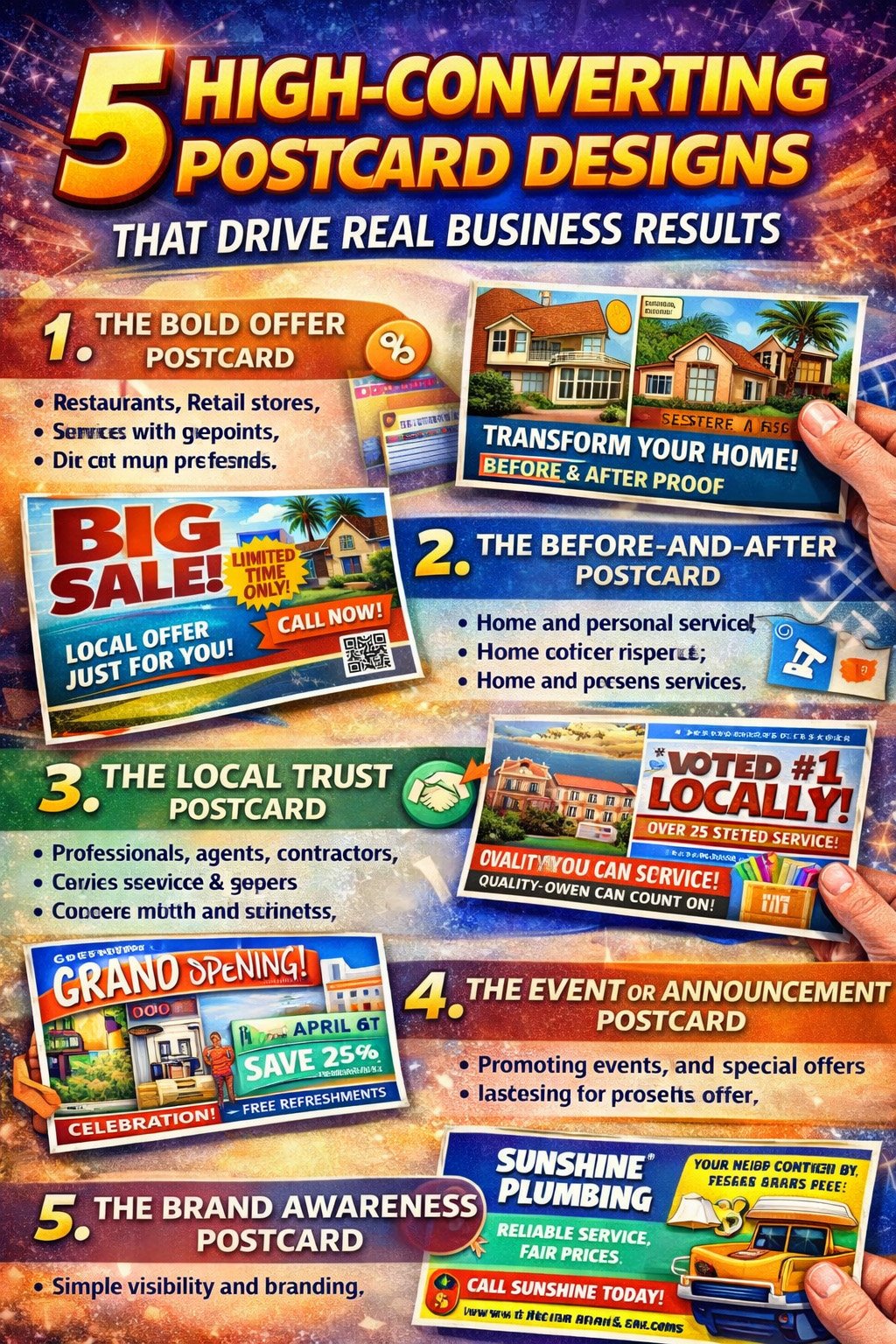
5 High-Converting Postcard Designs That Drive Real Business Results

  article 5

In postcard marketing, design is not just about appearance. It is about performance. A postcard can be beautifully printed, full color, and professionally produced, but if the design does not capture attention and move the reader to act, it will not produce strong results. The best postcards do more than look good. They convert.

A high-converting postcard design helps a business stand out in the mailbox, communicate value quickly, and guide the recipient toward a clear action. Whether the goal is more calls, more appointments, more store visits, or more website traffic, design plays a major role in response.

The good news is that successful postcard design is not based on guesswork. Certain formats and layout strategies consistently perform well because they match how people scan information, evaluate offers, and make decisions. Below are five postcard design approaches that can drive real business results when used the right way.

1. The Bold Offer Postcard

The bold offer postcard is one of the most effective designs in direct mail because it leads with a clear, valuable promotion. This type of postcard puts the offer front and center so the reader understands immediately what they gain by responding.

Examples include:

  • 20% off your first service
  • Free consultation or estimate
  • Buy one, get one free
  • Limited-time seasonal savings

This design works because it answers the recipient’s biggest question right away: “What is in it for me?” A strong offer creates instant relevance and reduces hesitation. The layout should make the promotion the visual star of the postcard, using large text, high contrast, and a call to action that feels urgent and easy to follow.

Best for:

  • Restaurants
  • Retail stores
  • Home services
  • Dental and medical promotions
  • Fitness and wellness offers

2. The Before-and-After Postcard

The before-and-after design is powerful because it shows transformation instead of just describing it. This visual proof format helps the recipient imagine the result they could experience by choosing your business.

It works especially well for industries where outcomes can be seen clearly, such as:

  • Landscaping
  • Roofing and exterior cleaning
  • Home remodeling
  • Dental care
  • Beauty and cosmetic services
  • Fitness programs

This kind of postcard is effective because the human brain responds strongly to contrast. Seeing a clear “before” and “after” makes the benefit feel real and believable. Instead of asking the recipient to imagine improvement, the postcard shows it.

To make this design work, keep the images clean and easy to compare. Pair them with a short headline, a benefit-driven statement, and a direct invitation to learn more or schedule a service.

3. The Local Trust Postcard

Some postcard campaigns work best when trust is the main driver of response. The local trust postcard is designed to make the business feel familiar, credible, and dependable. Instead of focusing first on discounts, this design emphasizes reputation, community presence, and proof of reliability.

Common elements include:

  • Customer testimonials
  • Years in business
  • Family-owned or locally owned messaging
  • Licenses, certifications, or awards
  • Photos of staff, team members, or storefronts

This design works because people often choose businesses they trust over businesses that simply offer the lowest price. A postcard that feels local and credible can lower resistance and make the recipient more comfortable responding.

Best for:

  • Real estate agents
  • Contractors and home service providers
  • Medical and dental practices
  • Insurance agencies
  • Local professional services

4. The Event or Announcement Postcard

The event or announcement postcard is designed to create awareness and excitement around something timely. This could be a grand opening, special event, seasonal promotion, new location, limited-time launch, or customer appreciation event.

This style performs well because urgency and timing naturally increase interest. When people know something specific is happening soon, they are more likely to pay attention and respond quickly.

Effective event postcards usually include:

  • A strong headline announcing what is happening
  • The event date or deadline
  • Important details such as time, place, or offer
  • A reason to act now
  • A clear next step

This design is especially useful for businesses trying to drive in-person traffic or short-term bursts of engagement. The layout should feel energetic, easy to scan, and focused on the event itself rather than general company information.

5. The Simple Brand Awareness Postcard

Not every postcard campaign needs a heavy promotion. Sometimes the goal is simply to get your business name into the minds of local customers so they remember you when they need your service. That is where the simple brand awareness postcard performs well.

This design usually includes:

  • A clean headline
  • A short explanation of what the business offers
  • Strong branding and contact information
  • A local or neighborhood message
  • A simple invitation to call, visit, or save the card

This kind of postcard works because familiarity builds over time. People often do not need your service the moment they receive the card, but repeated exposure helps them remember your name later. When the need appears, your business feels more familiar and more trustworthy.

Brand awareness postcards are ideal for service-based businesses that depend on staying top of mind in a specific territory.

What All High-Converting Postcards Have in Common

Even though these five designs serve different goals, the strongest postcard campaigns tend to share a few key traits:

  1. A clear headline that communicates the main message fast
  2. A focused purpose so the reader is not distracted by too many ideas
  3. Strong visual hierarchy that makes the most important elements stand out
  4. A compelling reason to act whether through value, trust, urgency, or relevance
  5. A direct call to action telling the recipient exactly what to do next

The biggest design mistake businesses make is trying to include too much information. The best postcards are not overloaded. They are focused, strategic, and easy to process in seconds.

How to Choose the Right Design for Your Business

The best postcard design depends on your campaign goal. If you want immediate leads, a bold offer postcard may be the right fit. If you need to prove visible results, a before-and-after layout may perform better. If trust is your main challenge, a local credibility design may be stronger. If you are promoting something timely, an event postcard makes more sense. And if your goal is long-term recognition, a brand awareness postcard can be highly effective.

The most important thing is alignment. Your postcard design should match the customer’s stage of awareness, the type of service you offer, and the action you want them to take.

Final Thoughts

A postcard does not need to be complicated to succeed, but it does need to be intentional. The strongest designs are the ones that understand attention, trust, clarity, and motivation. When a postcard is built around those principles, it becomes much more than a printed piece of mail. It becomes a conversion tool.

At BigPostcards.net, great postcard design is about helping businesses get seen, get remembered, and get results. Whether your goal is fast response or long-term brand growth, the right postcard format can turn mailbox space into measurable business success.
Big Postcards Related Articles

  • 5 High-Converting Postcard Designs That Drive Real Business Results
  • Big Postcards, Bigger Results: How Size Impacts Direct Mail ROI
  • Every Door Direct Mail (EDDM): The Ultimate Local Marketing Hack
  • From Mailbox to Money: How Postcards Turn Prospects Into Customers
  • How to Create a Postcard Campaign That Gets a 4–9% Response Rate
  • Postcard Marketing vs Email Marketing: Which Converts Better?
  • Targeted Direct Mail Secrets: Reaching the Right Audience Every Time
  • The $1 Marketing Strategy: How Postcards Deliver Massive ROI for Small Businesses
  • The Psychology Behind Postcard Marketing: Why People Actually Read Them
  • Why Postcard Marketing Still Works in 2026

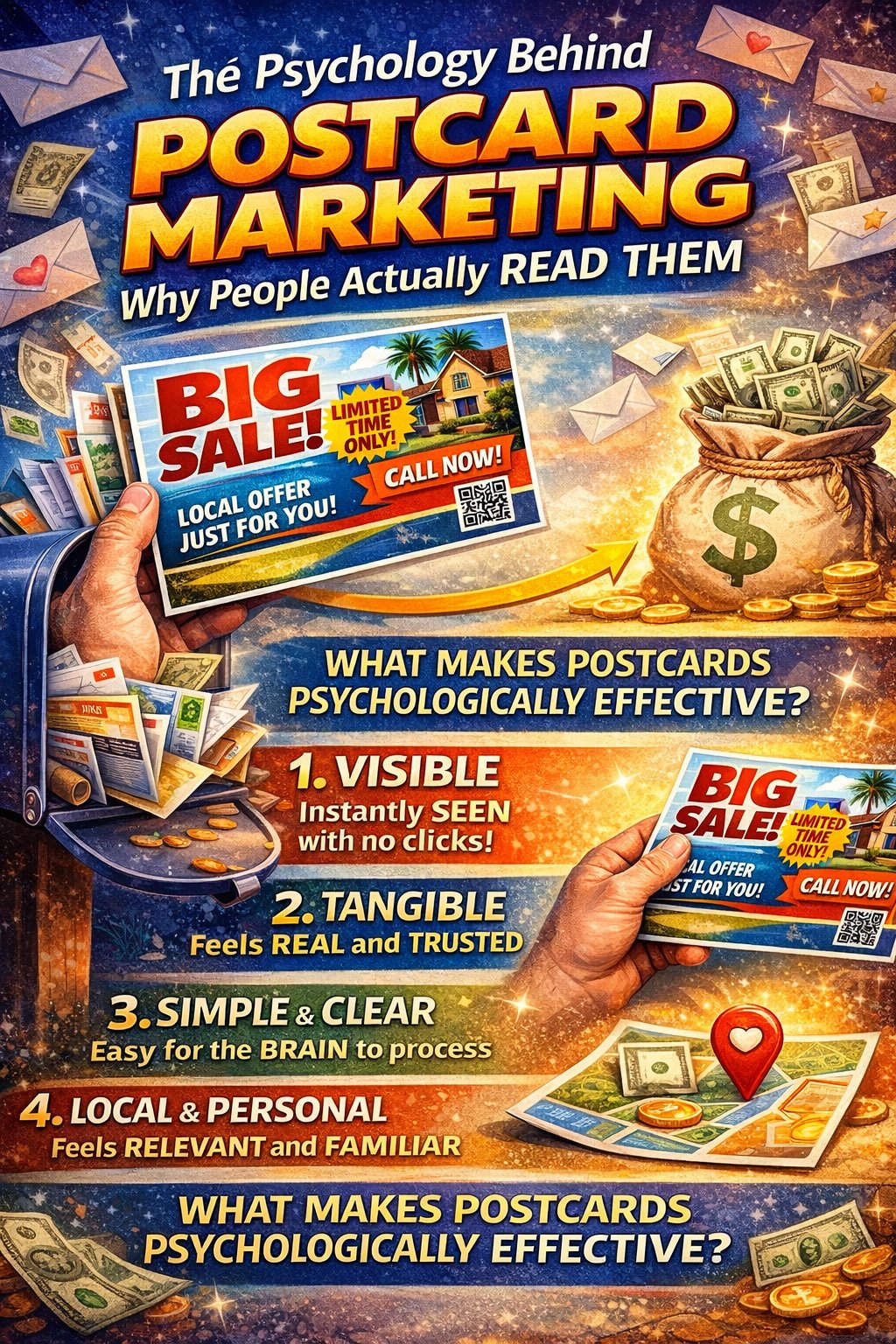
The Psychology Behind Postcard Marketing: Why People Actually Read Them

article 4

In a world full of pop-ups, paid ads, social media promotions, and inbox overload, getting people to stop and pay attention has become one of the biggest challenges in marketing. Businesses spend enormous amounts of time and money trying to win a few seconds of attention online. Yet one traditional format continues to hold surprising power in modern marketing: the postcard.

Postcard marketing works for a simple reason—it aligns with human behavior. People are more likely to notice, process, and remember messages that are visible, tangible, easy to understand, and emotionally relevant. That is exactly what postcards do. They reach people in a physical space, reduce friction, and create a more direct experience than many digital ads ever can.

To understand why postcards still perform so well, it helps to look at the psychology behind them. When you understand why people actually read postcards, you can design campaigns that feel more natural, more persuasive, and more effective.

Visibility Creates Instant Attention

One of the strongest psychological advantages of a postcard is that the message is already exposed. There is no envelope to open, no subject line to decide on, and no click required to reveal the offer. The recipient sees the image, headline, branding, and main message immediately.

This matters because human attention is selective and fast. People are constantly filtering information, deciding almost instantly what is worth noticing and what should be ignored. A postcard removes an extra step and makes the message effortless to access. That instant visibility gives it a better chance of entering awareness before the person decides to move on.

In psychology, reducing effort increases engagement. The easier something is to process, the more likely people are to give it a moment of attention. Postcards benefit from that principle naturally.

Tangible Objects Feel More Real

Digital content often feels temporary. A message appears, disappears, and is replaced by another within seconds. A postcard feels different because it is physical. It exists in the real world. It can be held, turned over, placed on a table, pinned to a board, or saved for later.

That physical presence affects perception. Tangible materials often feel more serious, more intentional, and more trustworthy than something that flashes by on a screen. People tend to place greater mental value on objects they can physically interact with. This is one reason direct mail often feels more credible than digital advertising.

For businesses, this means a postcard can create a stronger sense of legitimacy. Instead of seeming like just another online promotion, it feels like a direct communication from a real business trying to make a real connection.

Simplicity Helps the Brain Process the Message

Another reason people read postcards is that postcards are usually simple. They tend to focus on one message, one offer, and one action step. That simplicity makes them easier for the brain to process quickly.

People do not like cognitive overload. When a message is cluttered, confusing, or full of too many competing ideas, the brain often rejects it. A good postcard avoids that problem. It delivers a short, visually clear communication that answers the most important questions fast:

  • Who is this from?
  • What is being offered?
  • Why should I care?
  • What should I do next?

This clarity is powerful because it reduces mental resistance. The easier a message is to understand, the easier it is to act on.

Novelty Makes People Pause

People become blind to patterns they see too often. Online, most promotions look familiar: banner ads, sponsored posts, pre-roll videos, retargeting ads, and email offers all compete for attention in highly repetitive ways. Because of that repetition, many consumers automatically tune them out.

A postcard can interrupt that pattern. In a digital-heavy environment, physical mail feels different. That difference creates novelty, and novelty naturally attracts attention. The brain is wired to notice what stands out from the expected environment.

Even if someone receives mail regularly, a well-designed postcard can still create a small pattern break that makes the recipient stop, look, and read. That pause is valuable. In marketing, even a few extra seconds of focused attention can dramatically increase response.

Postcards Trigger Local and Personal Relevance

Relevance is one of the most important psychological drivers of response. People pay more attention when a message feels connected to their life, location, needs, or identity. Postcards are especially strong at creating that feeling because they often target specific neighborhoods, communities, or customer groups.

A postcard that promotes a nearby business, a local event, or a service available in the recipient’s area feels more relevant than a random online ad from a company they have never heard of. It creates the sense that the message was meant for them.

This local relevance is one reason postcards work so well for:

  • Home services
  • Restaurants and local offers
  • Dental and medical offices
  • Retail store promotions
  • Real estate marketing
  • Community announcements and events

When the offer feels close, useful, and timely, people are much more likely to read and respond.

Trust Grows Through Familiarity

One of the most studied ideas in psychology is the familiarity effect. The more often people see something, the more comfortable and believable it tends to feel. Postcards help build familiarity because they place the business name, logo, colors, and offer directly into the home.

A person may not respond the first time they receive a postcard, but that first exposure still matters. The next time they see the business name online, pass the storefront, or hear someone mention the company, it feels more familiar. That familiarity lowers resistance and increases the chance of future action.

This is why repeated postcard campaigns often outperform one-time mailings. Trust rarely appears instantly. It grows through repeated, consistent exposure.

Emotion Plays a Bigger Role Than Most Businesses Realize

People do not make decisions based on logic alone. Emotion influences attention, memory, and action. A postcard that uses strong imagery, appealing colors, a warm local tone, or an exciting offer can create a small emotional response that makes the message more memorable.

Depending on the industry, that emotional trigger might be:

  • Relief from a household problem
  • Excitement about a sale or promotion
  • Curiosity about a new service
  • Confidence in a trusted local provider
  • Urgency tied to a limited-time offer

Emotion helps turn passive reading into active interest. When the postcard connects with a real need or desire, the recipient is far more likely to respond.

Clear Calls to Action Reduce Decision Friction

Another psychological strength of postcards is that they can guide action clearly. When a postcard says exactly what to do next—call, visit, book, scan, or redeem—it removes uncertainty. This matters because uncertainty often kills response.

People hesitate when they are not sure what step comes next. A strong postcard eliminates that hesitation with a direct and simple call to action. The easier the next step feels, the more likely the recipient is to take it.

Good postcards often use calls to action like:

  • Call today for your free quote
  • Bring this postcard in for 15% off
  • Scan the QR code to book now
  • Visit us this weekend for special savings

These instructions work because they reduce decision fatigue and turn intention into movement.

Why Businesses Should Pay Attention to This Psychology

Understanding why people read postcards is more than an academic exercise. It has direct business value. When you design postcards around real human behavior, your campaigns become stronger. You stop relying on guesswork and start using principles that naturally support attention, trust, and response.

Businesses that understand postcard psychology can create campaigns that are:

  • More visible
  • More memorable
  • More relevant
  • More persuasive
  • More likely to generate action

In a marketing environment where so many messages are ignored, these advantages matter.

Final Thoughts

Postcards work because they match the way people actually think and behave. They are visible, physical, easy to process, emotionally engaging, and often highly relevant. They reduce friction, support trust, and create a more memorable experience than many digital messages.

At BigPostcards.net, effective postcard marketing starts with understanding people—not just printing materials. When businesses respect attention, clarity, trust, and emotion, postcards become far more than simple mail pieces. They become powerful tools for getting read, getting remembered, and getting results.

Big Postcards Related Articles

  • 5 High-Converting Postcard Designs That Drive Real Business Results
  • Big Postcards, Bigger Results: How Size Impacts Direct Mail ROI
  • Every Door Direct Mail (EDDM): The Ultimate Local Marketing Hack
  • From Mailbox to Money: How Postcards Turn Prospects Into Customers
  • How to Create a Postcard Campaign That Gets a 4–9% Response Rate
  • Postcard Marketing vs Email Marketing: Which Converts Better?
  • Targeted Direct Mail Secrets: Reaching the Right Audience Every Time
  • The $1 Marketing Strategy: How Postcards Deliver Massive ROI for Small Businesses
  • The Psychology Behind Postcard Marketing: Why People Actually Read Them
  • Why Postcard Marketing Still Works in 2026

From Mailbox to Money: How Postcards Turn Prospects Into Customers

 article 3

In marketing, attention means very little unless it leads to action. A campaign can look impressive, sound clever, and reach thousands of people, but if it does not bring in leads, calls, bookings, or sales, it is not doing its job. That is why so many businesses continue to rely on postcard marketing. A well-made postcard is more than a printed promotion. It is a tool that can move people from curiosity to response, and from response to revenue.

In an era of crowded inboxes and nonstop digital advertising, direct mail postcards still offer something powerful: visibility, simplicity, and trust. They place your message directly into the hands of potential customers, making it easier to stand out and easier to be remembered. When designed with the right message and sent to the right audience, postcards can do exactly what every business wants—turn prospects into customers.

Why Postcards Still Matter in Modern Marketing

Many businesses assume customers only respond to digital marketing today, but that is not the full picture. While online advertising plays an important role, physical mail still creates a different kind of connection. A postcard arrives in a real mailbox, not a spam folder. It is seen without being opened. It can be held, saved, shared, or placed somewhere visible for later.

That physical presence helps postcards feel more intentional and more trustworthy. People may scroll past dozens of online messages in a few minutes, but a postcard often gets a more focused moment of attention. That moment can be enough to spark interest, trigger a need, and motivate someone to take the next step.

The Customer Journey Starts With Visibility

Every sale begins with awareness. Before someone can buy from your business, they need to know you exist, understand what you offer, and recognize why it matters to them. Postcards are excellent at creating this first stage of awareness because they put the message directly in front of the customer.

Unlike many other forms of advertising, postcards do not require a click before the message appears. The headline, image, business name, and offer are already visible. This gives postcard marketing a major advantage: it removes friction from the first interaction. A recipient can immediately understand what is being offered and decide whether it is relevant.

That is why postcards work so well for announcing:

  • New business openings
  • Special promotions and limited-time offers
  • Seasonal services
  • Real estate listings
  • Medical, dental, and wellness promotions
  • Restaurant deals and local events

Postcards Build Trust Faster Than Many Ads

Trust plays a major role in converting a prospect into a paying customer. People are more likely to respond when a business appears established, clear, and professional. A well-designed postcard helps create that impression.

Printed materials often feel more credible than online ads because they suggest that the business invested in reaching the customer directly. The message does not feel random or fleeting. It feels deliberate. For local businesses especially, this can create a strong sense of legitimacy.

A postcard can also include trust-building elements that make a recipient more comfortable responding, such as:

  • Customer testimonials
  • Years in business
  • Guarantees or warranties
  • Professional certifications
  • Before-and-after visuals
  • Clear contact information and website details

These details help move a person from “Who is this?” to “This looks like a business I can trust.”

A Strong Offer Turns Interest Into Action

Visibility gets attention, but offers create response. If you want a postcard to generate results, it needs to give prospects a compelling reason to act. The offer should be relevant, easy to understand, and connected to a clear next step.

Some examples of effective postcard offers include:

  • 10% off a first service
  • Free estimate or consultation
  • Limited-time package deal
  • Buy one, get one promotion
  • Free trial or introductory session
  • Exclusive neighborhood discount

The best offers reduce hesitation. They make it easier for a prospect to justify reaching out, booking, visiting, or buying. When that happens, the postcard becomes more than a reminder—it becomes a catalyst.

Simple Calls to Action Increase Conversions

One reason postcards work so well is that they can keep the message focused. Instead of overwhelming the reader with too many options, a strong postcard points to one main action. That action might be calling a number, scanning a QR code, visiting a website, redeeming a coupon, or stopping by a location.

The easier the next step feels, the better the postcard usually performs. A clear call to action tells the prospect exactly what to do and why they should do it now. This reduces confusion and makes the path to conversion much shorter.

Strong calls to action often use phrases like:

  • Call today for your free estimate
  • Scan now to claim your discount
  • Visit us this weekend for special savings
  • Book your appointment before the offer ends
  • Bring this card in for a local customer bonus

Targeting the Right Audience Makes All the Difference

Even the best postcard will struggle if it reaches the wrong people. That is why targeting is so important in direct mail. When you send postcards to neighborhoods, households, or customer segments most likely to need your product or service, your chances of conversion rise dramatically.

This is one reason postcard campaigns are so effective for local businesses. A roofing company can mail homes in specific zip codes. A dental office can promote new patient offers to nearby residents. A restaurant can advertise to households within delivery range. A real estate agent can send postcards to homeowners in a target area.

Relevance helps the recipient feel that the message applies to them, and relevance is one of the biggest drivers of response.

Postcards Support Repeat Exposure

Most customers do not respond the first time they see a business. That is normal. Marketing often works through repetition. A prospect may notice your postcard, set it aside, and then act days later when the need becomes urgent. Or they may see your business online later and remember the postcard they received.

This repeat exposure is valuable because familiarity reduces resistance. The more often people see your name and offer, the more comfortable they become with your brand. That is why many successful postcard campaigns are not one-time blasts. They are repeated mailings designed to stay top of mind until the prospect is ready to buy.

How Postcards Generate Real Revenue

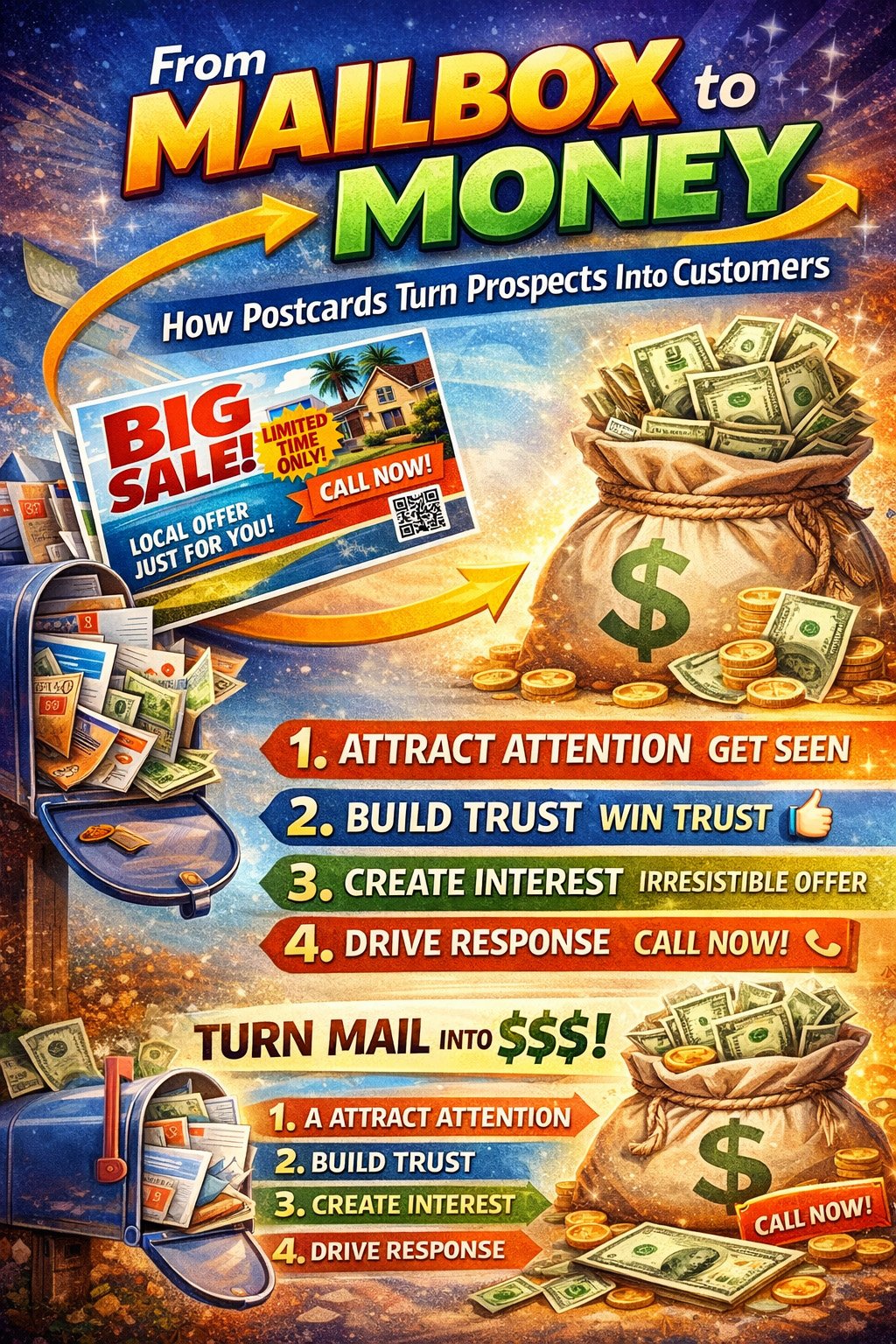
Postcards create revenue by moving prospects through a practical sequence:

  1. They attract attention with bold design and immediate visibility.
  2. They build trust through physical presence and clear branding.
  3. They create interest with relevant offers and customer-focused messaging.
  4. They drive response with a simple and direct call to action.
  5. They support conversion by making it easy for prospects to contact or visit the business.

When all of these pieces work together, the result is a campaign that does more than inform. It produces leads, sales, and long-term customer relationships.

Best Industries for Postcard Marketing

Postcards can work across many industries, but they are especially powerful for businesses that rely on local reach, recurring services, or strong offers. Some of the best fits include:

  • Home services such as plumbing, HVAC, roofing, and landscaping
  • Dental and medical practices
  • Restaurants and food delivery businesses
  • Retail stores and boutiques
  • Real estate professionals
  • Fitness, beauty, and wellness services

In these industries, the path from postcard to purchase can be short and highly measurable.

Final Thoughts

The path from mailbox to money is not magic. It is strategy. A postcard works when it reaches the right audience with the right message, the right offer, and the right call to action. When those elements are in place, postcards can turn attention into inquiries, inquiries into customers, and customers into repeat business.

At BigPostcards.net, postcard marketing is more than print. It is a practical way to help businesses get noticed, generate leads, and grow revenue. In a crowded world, the businesses that win are often the ones that show up where people actually look—right in the mailbox.

Big Postcards Related Articles

  • 5 High-Converting Postcard Designs That Drive Real Business Results
  • Big Postcards, Bigger Results: How Size Impacts Direct Mail ROI
  • Every Door Direct Mail (EDDM): The Ultimate Local Marketing Hack
  • From Mailbox to Money: How Postcards Turn Prospects Into Customers
  • How to Create a Postcard Campaign That Gets a 4–9% Response Rate
  • Postcard Marketing vs Email Marketing: Which Converts Better?
  • Targeted Direct Mail Secrets: Reaching the Right Audience Every Time
  • The $1 Marketing Strategy: How Postcards Deliver Massive ROI for Small Businesses
  • The Psychology Behind Postcard Marketing: Why People Actually Read Them
  • Why Postcard Marketing Still Works in 2026

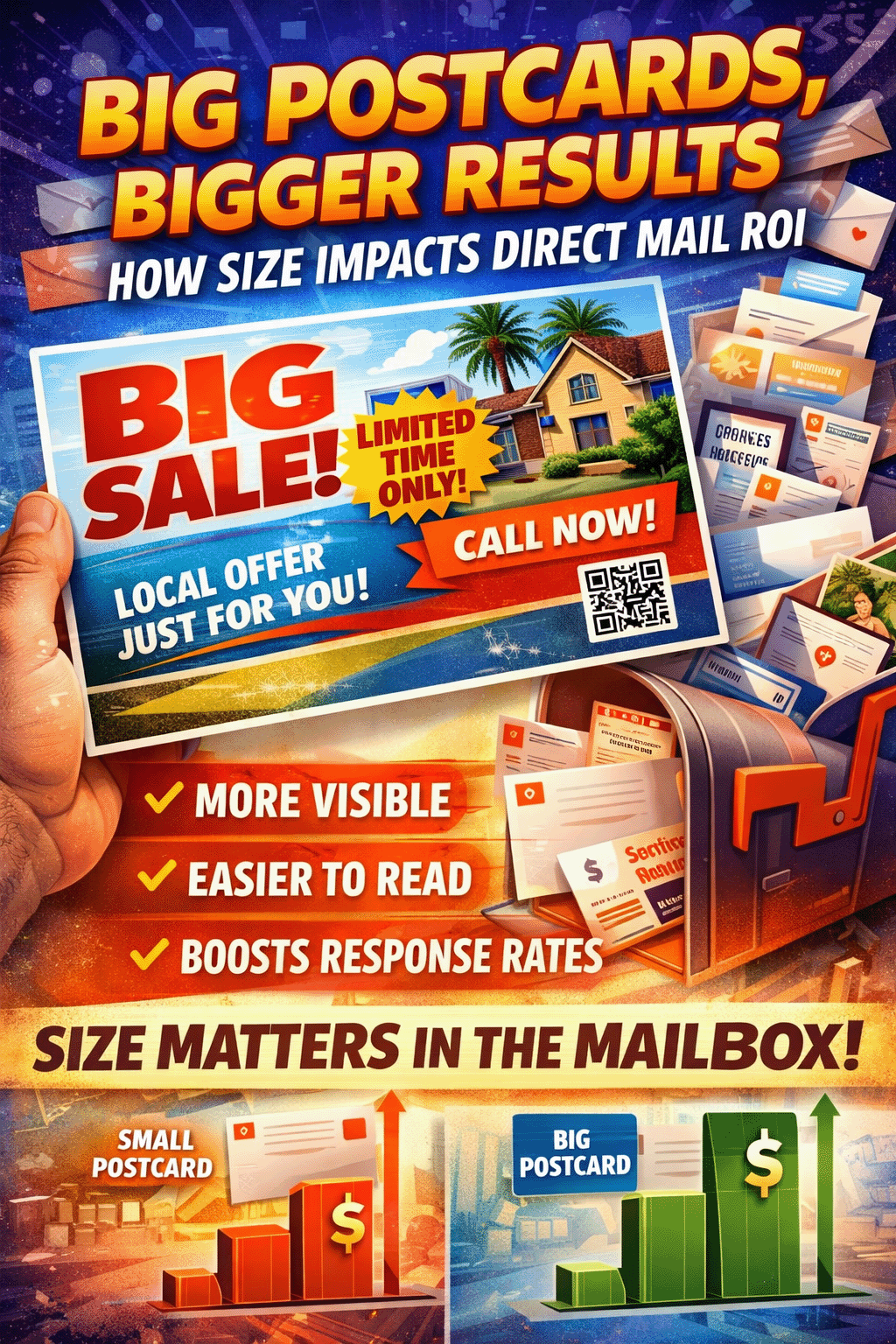
Big Postcards, Bigger Results: How Size Impacts Direct Mail ROI

 article 2

In direct mail marketing, getting noticed is the first battle. If your message does not capture attention, it cannot generate calls, clicks, visits, or sales. That is one reason big postcards continue to be a smart choice for businesses that want stronger results from their campaigns. When a postcard is larger, it naturally commands more attention in the mailbox and creates more room for persuasive design, clear offers, and memorable branding.

Many businesses focus on the wording of a promotion or the quality of a mailing list, but postcard size can also make a significant difference. In fact, the format of your piece can directly affect how often it gets noticed, how easy it is to read, and how strongly it motivates action. If your goal is to improve direct mail ROI, postcard size should not be an afterthought. It should be part of your strategy.

Why Size Matters in Direct Mail

The mailbox is a competitive space. Letters, flyers, catalogs, coupons, bills, and promotional pieces all compete for a few seconds of attention. A larger postcard has an immediate advantage because it is more visible at first glance. It physically stands out from smaller mail pieces and often feels more important.

This matters because most people make fast decisions about what to keep, what to read, and what to throw away. A postcard that looks substantial has a better chance of surviving that first quick sorting moment. Even before the recipient reads your message, the larger size signals value, confidence, and presence.

Big Postcards Grab Attention Faster

One of the greatest advantages of oversized postcards is simple: they are harder to ignore. A bigger card gives your headline more visual power, your images more impact, and your offer more breathing room. Instead of looking cramped or crowded, your message can appear bold, clean, and easy to understand.

In marketing, speed matters. People often decide within seconds whether a message is relevant to them. Larger postcards help you make a stronger first impression by putting the key message front and center. Whether you are promoting a seasonal sale, introducing a local service, or announcing a special offer, size can help your campaign get noticed immediately.

More Space Means Better Communication

A larger postcard does more than attract attention. It gives you more room to communicate clearly. That extra space can be used for a stronger headline, a clearer explanation of the offer, a compelling image, testimonials, coupons, QR codes, phone numbers, website details, and a more obvious call to action.

Smaller postcards can work, but they often force businesses to choose between design and information. With a large postcard, you do not have to sacrifice readability just to fit your message. You can organize the layout in a way that feels inviting instead of overwhelming.

This is especially important when you want recipients to take a specific next step, such as:

  • Calling for a free estimate
  • Booking an appointment
  • Redeeming a discount
  • Visiting a store or showroom
  • Scanning a QR code to learn more
  • Going online to claim an offer

When your message is easy to follow, people are more likely to respond.

Large Postcards Improve Brand Presence

Brand recognition is a major part of successful marketing. The more often people notice and remember your business, the more likely they are to trust you when they are ready to buy. Large postcards help strengthen brand presence because they give your logo, colors, visuals, and messaging more room to stand out.

This can be especially valuable for local businesses trying to become the obvious choice in their area. A bold postcard that arrives in homes throughout a neighborhood can make your company feel established and visible. Instead of blending in with smaller mailers, your business takes up space—literally and mentally.

How Size Can Impact Direct Mail ROI

Direct mail ROI depends on more than printing costs. It depends on the total performance of the campaign: how many people notice it, read it, remember it, and take action because of it. While larger postcards may cost more than smaller formats, they can also deliver better results by increasing response and conversion rates.

When a campaign produces more calls, more leads, more store visits, or more booked appointments, that added response can easily justify the higher print investment. In many cases, the real cost is not using a slightly bigger postcard. The real cost is sending a smaller one that gets overlooked.

Businesses should think in terms of results, not just unit price. A cheaper postcard that performs poorly is often more expensive in the long run than a larger postcard that generates real action.

Best Uses for Big Postcards

Big postcards work especially well when the goal is to create visibility and urgency. They are ideal for campaigns such as:

  • Grand openings
  • Seasonal promotions
  • Limited-time discounts
  • Neighborhood service marketing
  • Real estate promotions
  • Restaurant mailers
  • Medical and dental office offers
  • Home service campaigns for roofing, HVAC, plumbing, and landscaping

In each of these situations, a larger postcard helps the business appear more visible, more serious, and more prepared to serve the customer.

Design Tips for Large Postcards

Bigger postcards offer more creative freedom, but they still need strong design discipline. More space is only valuable if it is used well. The best postcard designs are clear, focused, and easy to scan.

Here are a few essential design principles:

  1. Lead with one strong headline that communicates the main benefit immediately.
  2. Use one primary offer so the reader knows exactly what is being promoted.
  3. Choose bold visuals that support the message and attract attention.
  4. Keep the layout clean with enough space around important elements.
  5. Make the call to action obvious with large, readable contact details.

The goal is not to fill every inch of the postcard. The goal is to use the added space to make the message more powerful and more readable.

Big Postcards and Local Targeting Work Well Together

Size becomes even more powerful when combined with a targeted mailing strategy. If you are sending postcards to a carefully selected neighborhood, customer list, or route, a larger format helps your message dominate attention in that area. This combination of reach and visibility is what makes postcard campaigns especially effective for local businesses.

Instead of relying only on digital ads that may or may not be seen, a large postcard arrives directly at the home, where it has a strong chance of being noticed by the household. For service businesses and local brands, that kind of direct presence is hard to beat.

Choosing the Right Postcard Size for Your Campaign

The right size depends on your goal, your offer, and your audience. Some campaigns may only need a moderate-sized postcard, while others benefit from a larger format that delivers maximum visual punch. If your promotion depends on strong imagery, detailed messaging, or premium brand positioning, a bigger card is often the better option.

It is also worth considering customer value. If one new customer is worth hundreds or thousands of dollars over time, even a modest increase in response rate can make a larger postcard extremely profitable.

Final Thoughts

In direct mail, size can have a real impact on performance. Big postcards attract attention faster, communicate more clearly, strengthen brand presence, and often improve overall campaign results. When businesses focus only on print cost and ignore visibility, they miss one of the most important drivers of response.

If you want your direct mail to stand out, get read, and produce measurable results, bigger may be better. At BigPostcards.net, larger postcard formats help businesses turn mailbox space into marketing power. When your message is worth sharing, it deserves to be seen in a big way.

Big Postcards Related Articles

  • 5 High-Converting Postcard Designs That Drive Real Business Results
  • Big Postcards, Bigger Results: How Size Impacts Direct Mail ROI
  • Every Door Direct Mail (EDDM): The Ultimate Local Marketing Hack
  • From Mailbox to Money: How Postcards Turn Prospects Into Customers
  • How to Create a Postcard Campaign That Gets a 4–9% Response Rate
  • Postcard Marketing vs Email Marketing: Which Converts Better?
  • Targeted Direct Mail Secrets: Reaching the Right Audience Every Time
  • The $1 Marketing Strategy: How Postcards Deliver Massive ROI for Small Businesses
  • The Psychology Behind Postcard Marketing: Why People Actually Read Them
  • Why Postcard Marketing Still Works in 2026

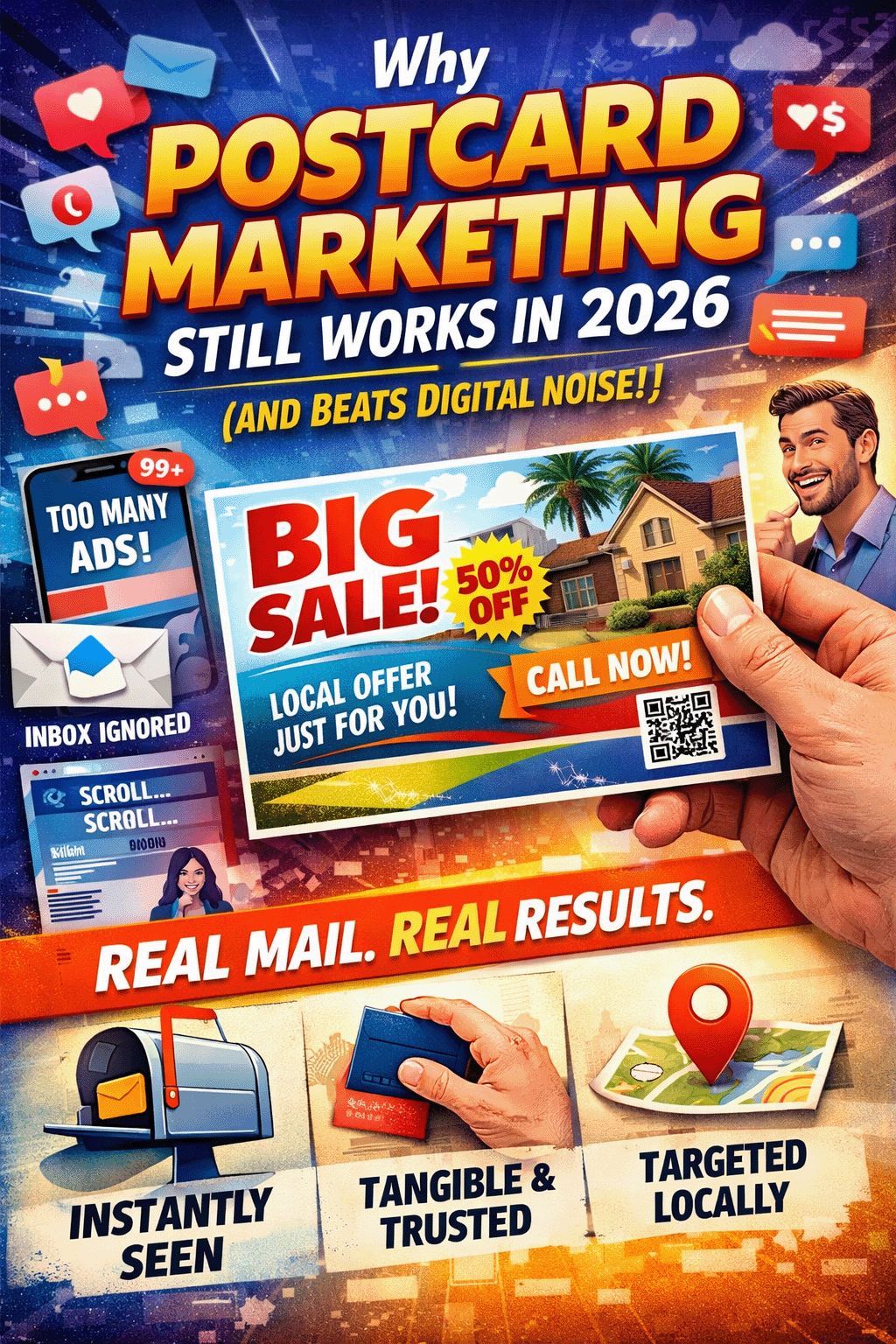
Why Postcard Marketing Still Works in 2026

 article 1

In a world overflowing with emails, pop-ups, text alerts, social media ads, and endless scrolling, getting your message noticed has become harder than ever. Businesses today face a serious challenge: how do you stand out when people are bombarded by digital marketing every minute of the day? One proven answer is surprisingly simple—postcard marketing.

While many companies focus only on digital channels, smart marketers know that direct mail postcards still deliver strong results. In 2026, postcard marketing remains one of the most effective ways to get attention, build trust, and drive action. A well-designed postcard lands directly in a customer’s hands, creates instant visibility, and avoids the clutter of crowded inboxes and ad-saturated feeds.

The Problem With Digital Noise

Digital marketing has undeniable advantages, but it also comes with serious limitations. Consumers are exposed to hundreds, sometimes thousands, of online messages every day. Many emails go unopened. Ads are skipped. Pop-ups are blocked. Social content disappears in seconds. Even when people see a message, they may forget it almost immediately because digital content moves fast.

This is what marketers mean by digital noise—the constant stream of online information competing for attention. The more crowded the digital space becomes, the harder it is for brands to make a lasting impression. That is why many businesses are rediscovering the value of physical mail, especially postcards.

Postcards Get Seen Right Away

One of the biggest strengths of postcard advertising is immediate visibility. Unlike a letter that must be opened, a postcard puts your message front and center. The recipient sees your headline, image, branding, and offer instantly.

That matters because attention is everything in marketing. A postcard does not ask someone to click first, open first, or tap first. The message is already there. This simple advantage helps postcards cut through the distractions that weaken many digital campaigns.

A bold design, strong headline, and clear call to action can make a postcard memorable in just a few seconds. For businesses trying to reach local customers, promote sales, announce grand openings, or generate leads, that instant visibility is incredibly powerful.

Physical Marketing Feels More Real

Digital content often feels temporary. It flashes on a screen and disappears just as quickly. A postcard is different. It is tangible. People can hold it, place it on a counter, pin it to a board, or keep it for later. That physical presence gives postcard marketing a staying power many digital ads lack.

A printed postcard can also create a stronger sense of legitimacy. When a business invests in direct mail, it often feels more established and trustworthy. This can be especially useful for local businesses, service providers, home improvement companies, medical offices, restaurants, real estate agents, and retail shops that want to build confidence with nearby customers.

Postcards Work Extremely Well for Local Marketing

If your business depends on serving a local area, postcards can be one of the smartest tools in your marketing mix. They allow you to target neighborhoods, zip codes, routes, or mailing lists with precision. Instead of broadcasting your message to everyone online, you can send it directly to the homes most likely to buy.

This is why local marketing postcards are still widely used for:

  • Restaurant promotions and coupons
  • Roofing, plumbing, and HVAC services
  • Real estate listings and just-sold announcements
  • Dental, medical, and wellness office promotions
  • Retail sales and seasonal events
  • Political campaigns and community announcements

With the right mailing strategy, businesses can put their message directly in front of the exact communities they want to reach.

Big Postcards Make an Even Bigger Impact

Size matters in direct mail. Larger postcards naturally stand out more in the mailbox. They give you more room for strong visuals, persuasive copy, special offers, testimonials, and branding. A bigger format can instantly make your message look more important and more professional.

For businesses that want maximum visibility, big postcards offer a major advantage. They are harder to ignore, easier to read, and better suited for bold promotional designs. Whether you are announcing a sale, introducing a new service, or trying to dominate a local market, a larger postcard helps your campaign make a stronger impression.

Postcards Support Digital Marketing Instead of Replacing It

Some people treat direct mail and digital marketing like opposites, but the most successful businesses use both together. A postcard can drive traffic to your website, landing page, Google Business Profile, online store, or social media page. It can also reinforce the brand people have already seen online.

For example, a customer may notice your ad on social media but forget about it a few hours later. Then your postcard arrives in the mail with the same branding and offer. Suddenly your message feels familiar, trustworthy, and timely. This combination can improve recall and increase response.

In 2026, integrated campaigns work especially well. Postcards can include:

  • QR codes linked to landing pages
  • Promo codes for online orders
  • Personalized URLs
  • Tracking phone numbers
  • Appointment booking links
  • Social media handles and review links

When direct mail and digital channels work together, your marketing becomes more consistent and more persuasive.

Postcard Campaigns Can Be Simple and Cost-Effective

Another reason postcard marketing still works is that it can be straightforward to execute. You do not need a huge budget or a complicated funnel to launch a successful campaign. With the right design, a compelling offer, and a targeted mailing list, even a simple postcard can drive real results.

Businesses often use postcard campaigns for:

  • Seasonal promotions
  • Grand openings
  • Customer reactivation
  • Referral offers
  • New product or service launches
  • Brand awareness in specific neighborhoods

Because postcards are easy to understand and quick to scan, they are especially effective when the message is clear and the action step is simple.

What Makes a Postcard Campaign Successful?

Not every postcard gets results. The strongest campaigns are built around a few key elements:

  1. A clear headline that grabs attention immediately
  2. A compelling offer that gives people a reason to act now
  3. Strong visual design that is clean, bold, and easy to read
  4. A focused audience based on geography, demographics, or customer data
  5. A simple call to action such as calling, scanning, visiting, or booking

The most effective postcards do not try to say everything. They focus on one main message and one desired action. That clarity is what turns a printed card into a true marketing tool.

Why Postcard Marketing Still Wins in 2026

Postcard marketing still works in 2026 because human behavior has not changed as much as technology has. People still notice what is tangible. They still respond to clear offers. They still appreciate messages that feel direct, relevant, and easy to understand.

While digital platforms become more crowded and competitive, postcards continue to offer something refreshing: a real-world marketing experience that shows up where people live. That gives businesses a unique opportunity to be seen, remembered, and acted on.

Final Thoughts

If your business is looking for a practical, proven way to break through digital clutter, postcard marketing deserves serious attention. It is visible, physical, targeted, and effective. Whether you want more local awareness, more calls, more appointments, or more sales, postcards remain a smart investment for brands that want results.

At BigPostcards.net, the right postcard is more than printed mail—it is a marketing tool designed to get your business noticed. In a noisy world, sometimes the simplest message in the mailbox is the one people remember most.

Big Postcards Related Articles

  • 5 High-Converting Postcard Designs That Drive Real Business Results
  • Big Postcards, Bigger Results: How Size Impacts Direct Mail ROI
  • Every Door Direct Mail (EDDM): The Ultimate Local Marketing Hack
  • From Mailbox to Money: How Postcards Turn Prospects Into Customers
  • How to Create a Postcard Campaign That Gets a 4–9% Response Rate
  • Postcard Marketing vs Email Marketing: Which Converts Better?
  • Targeted Direct Mail Secrets: Reaching the Right Audience Every Time
  • The $1 Marketing Strategy: How Postcards Deliver Massive ROI for Small Businesses
  • The Psychology Behind Postcard Marketing: Why People Actually Read Them
  • Why Postcard Marketing Still Works in 2026

Page 2 of 2

  • 1
  • 2

Policies

  • Privacy Policy
  • Terms of Service
  • Disclaimer
  • Help Desk